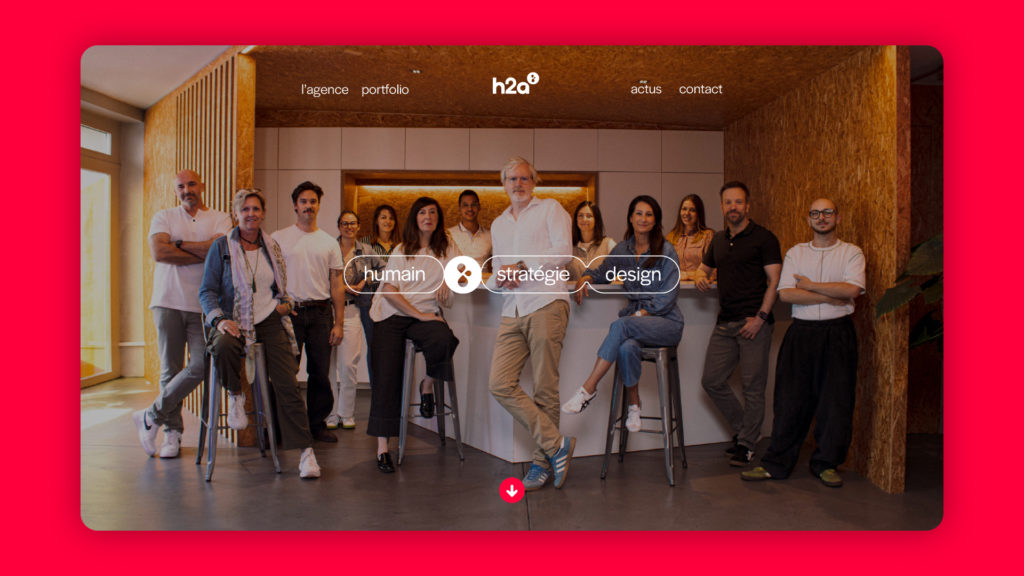
As you may have noticed if you follow us on social media, we were once again at the Web Summit in Lisbon. And this year, the whole agency was there! Let us tell you about our adventures.
In terms of numbers, the summit drew more than 70,000 participants this year, including over 1,000 speakers and 3,000 startups.
Naturally, the central theme was artificial intelligence and its impact on society, on creation and on technology in general.
Special mention this year: Pharrell Williams was present at the Opening Night!

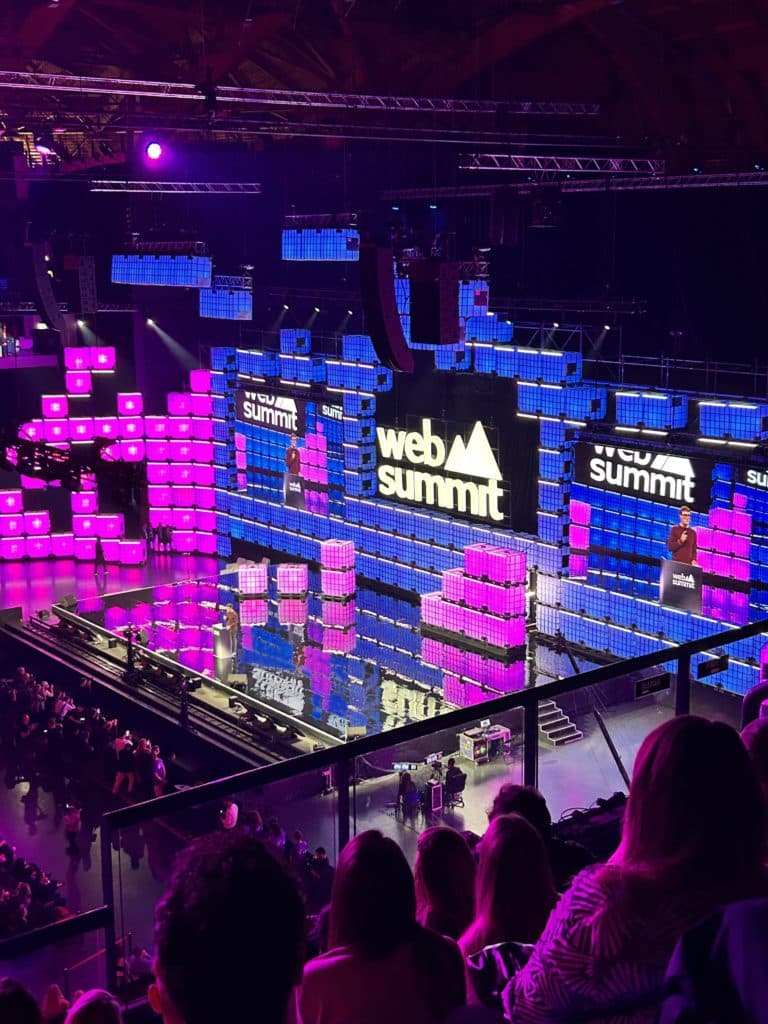
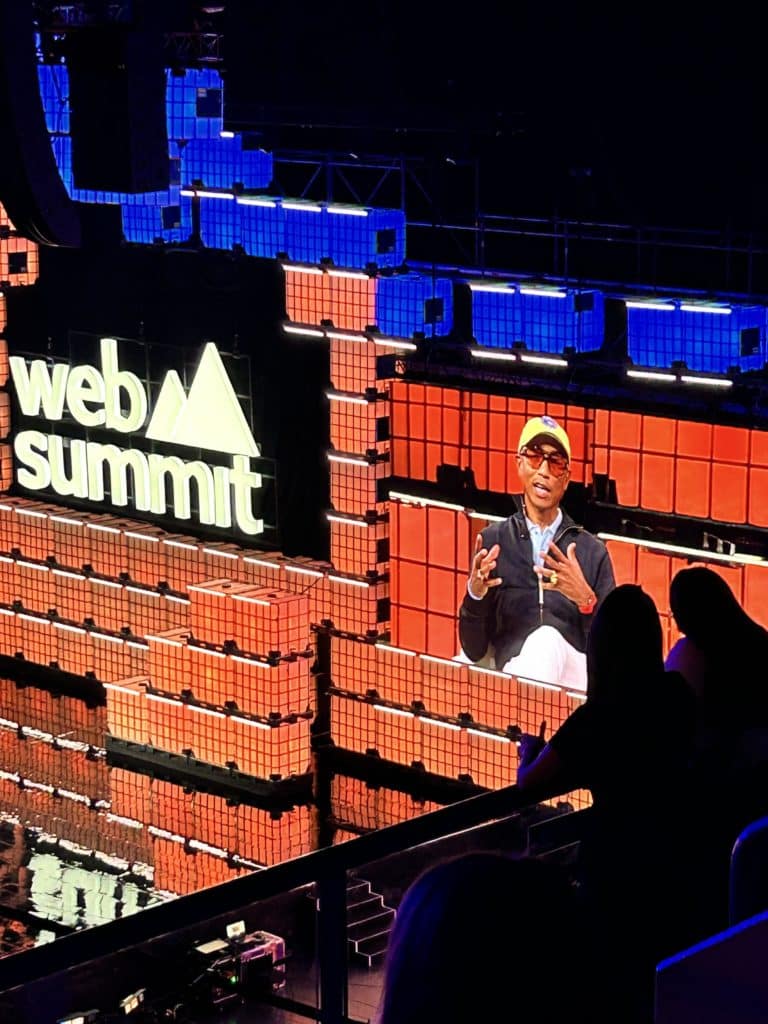
Scooters, sangria and pastéis de nata were of course on the menu for this unique 2024 edition for h2a. And this year we even had the chance to meet Xavier Bettel.
Here are a few moments from our adventure!
We attended inspiring talks that stimulated our creativity. Below are some of the topics that particularly interested us.
Imagining innovation differently
Several of the talks we attended started from the same observation: all the innovation of recent years has led us to the same habits. Whether you are looking for a hotel for an incredible stay, software for your work, a social network or a streaming platform, all web interfaces look alike: we spend our time scrolling through blocks of content on our screens.
Internet Sucks
A talk by Dan Gardner, Co-Founder and Executive Chairman of Code and Theory
Dan Gardner’s introduction was as follows: the internet sucks.
His premise is that since the first developments on the web, nothing has really improved for the better: people have never been so unhappy and so alone, even though they are in constant contact with the entire planet.
And on the other hand, our revolutionary technology is not as revolutionary as all that: we are still searching for a forgotten password or being bombarded with windows asking us to accept cookies. Seen this way, there is certainly food for thought.
The aim of this talk was to raise awareness that we must innovate differently.
Here are the main watchwords for addressing this:
“EMBRACE FRICTION”: accept points of friction. Friction is what makes experiences memorable.
“DESIGN FOR WONDER”: design for wonder. Curiosity and discovery make digital experiences captivating.
“BUILD FOR RELATIONSHIPS”: build for relationships. People need connection, not just achievement.
In other words, we must not simply create for the sake of creating, but give meaning to what we do, and above all never forget why we do it.
To rewatch the “Internet Sucks” talk, here it is.
The uniformization of everything
A talk by Sairah Ashman, Global CEO of Wolff Olins
Sairah Ashman opened her talk by recalling some key facts:
Today:
- Up to 5,000 marketing messages are seen per day
- 90% of people cannot remember a brand they saw yesterday
- More than 4 trillion dollars is spent on marketing every year
- 85% of that money is wasted on brand media that will probably go unnoticed.
Overall, it is clear that only very few marketing campaigns manage to truly stand out.
In the spirit of innovating in the right direction, this talk invited us to create something completely new, something that may not seem achievable at first glance.
The Wolff Olins agency is behind the visual identity of Tate Modern in London, which had a major impact when it was launched.
Here is what this talk reminded us:
- Uncover your essence: reveal your true nature
- Do what you can’t: do what you cannot do
- Rebuild with character: rebuild with character
- Conviction over consensus: your conviction must come before consensus
By following these key points, the goal is to give real meaning to one’s creation, to step off the beaten track and to break away from general uniformity.
AI and immersive web: building the internet of tomorrow
A talk by Sam Huber, Infinite Reality
According to the speaker, the future of the internet can be described in three points:
- More immersive
- Powered by AI
- Owned by creators
One example is a Mercedes café (AMG Kaffeehaus) in Dubai, which turns the coffee ritual into a luxury experience. Here, people can come for a coffee or a meal, surrounded by an art exhibition and, of course, models of the brand on display.
- Experiences are what we remember most, more than advertising.
The internet will become more immersive because there will be a more direct, better exchange with the customer. A website alone cannot create a personalized experience, but AI can.
- AI is about to revolutionize the online experience, because it makes it possible to create personalized interactions at scale and speeds up content creation by a factor of 1,000.
The example given was a Manchester United shop in 3D, with an avatar acting as a salesperson. We asked for a gift for our nephew. She made suggestions based on our answers and asked questions to refine the results (the nephew’s age, whether he has a favorite player…). We replied that he has a favorite player but we could not remember his name, only that he had scored a lot of points last season. She managed to find his name and suggested suitable products.
The great thing about AI is that when you go to an e-commerce site, you know what you want; here, AI suggests products based on our needs.
- Immersion is a natural evolution of online media, and 3D media are the next medium.
The company sought to give power back to creators and businesses by equipping them with technologies that let them create their own space rather than ‘renting’ an audience from social networks. Indeed, on social networks we have followers but know nothing about them. Monetizing the audience is difficult.
They propose creating a site as a 3D platform (metaverse), allowing exchanges with customers and creating engaging experiences:
- for after-sales service or a helpline, for example (such as a telephone operator, which can lead to the order of a new phone),
- to create an experience and allow tickets or products to be bought online (such as a tourist office).
How UX transforms products: the revolution led by design
A talk by Mauricio Barros, CCO of Deeploy.Me
Mauricio Barros explores the constantly evolving world of UX design and its growing impact on products across different sectors. Discover how new tools and trends are expanding the influence of designers, transforming product development and shaping the future of design.
User experience (UX) is redefining how products are designed, developed and succeed in today’s market. By placing users’ needs at the center and relying on design-based strategies, UX accelerates development cycles and increases engagement by up to 21%. Its financial impact is just as impressive, with a return on investment reaching $100 for every dollar invested.
The influence of UX goes beyond aesthetics, integrating cognitive and physical elements to design more effective and impactful products. From increased sales (+14%) to improved customer loyalty (+44%), UX delivers measurable business results. It also fuels data-driven growth, ensuring faster and more efficient results.
Success stories highlight design-driven innovation, where every product starts with user testing, audience analysis and design thought through from the outset.
Modern UX encompasses several specialties, such as service design, visual design, motion design, UX research, product design and even UX writing. Together, these roles optimize the effectiveness of artificial intelligence. UX does not only build products: it shapes their future, ensuring they are functional, attractive and in line with user expectations.
Why creatives matter more than ever in a world of GenAI
A talk by Claire Darley, SVP at Adobe, and Andy Lambert, Senior Product Manager, Adobe Express, Adobe
As barriers to content creation fall and volumes explode, only the most captivating work will manage to stand out. Claire Darley and Andy Lambert discussed the importance of lightening repetitive tasks and allowing creatives to focus on their strengths. Together, they explored how to integrate generative artificial intelligence (GenAI) at every stage of the process, from ideation to publication, in order to save time while keeping human intuition and analysis at the heart of the magic that GenAI cannot reproduce.
In a content-saturated landscape, standing out has never been harder. The rise of generative AI has created a paradox: more content is produced, yet engagement keeps declining, particularly on platforms such as Instagram. Too often, authentic content gets drowned out by the noise, while genuine creations remain buried and invisible.
This is where human creativity shows its irreplaceable power. Unlike algorithms, human storytelling forges a deeper connection, sparks interest and prompts action. Creativity is not a commodity; it is a unique expression of our individuality.
Tools such as Adobe Firefly show the potential of AI to complement, not replace, creative talent. By saving countless hours of production, AI allows artists to focus on what matters: telling captivating stories and exploring new creative possibilities. This means more time for ideation, less time spent on repetitive tasks, and the ability to create core assets faster than ever. AI becomes a tool to amplify human creativity, without overshadowing it.
The demand for creatives has never been greater, yet resources and time are often limited. What would you create if production time were not an obstacle? By closing the content paradox and balancing technology and art, we can rediscover our creative power and reveal the unique magic that only humans can offer.
Accessibility
Design for everyone: Accessibility at Apple
A talk by Sarah Herrlinger, Senior Director, Global Accessibility Policy & Initiatives at Apple Inc.
Apple has been using artificial intelligence for several years, in particular to deliver its digital accessibility features.
In a few key points, the Apple speaker discussed the state of digital accessibility and why it matters:
- It is a fundamental human right
- 1.3 billion people worldwide (1 in 6) live with a significant disability.
- The number of people aged over 65 is expected to double by 2050.
- People with disabilities represent the largest minority, one that everyone can join at any time.
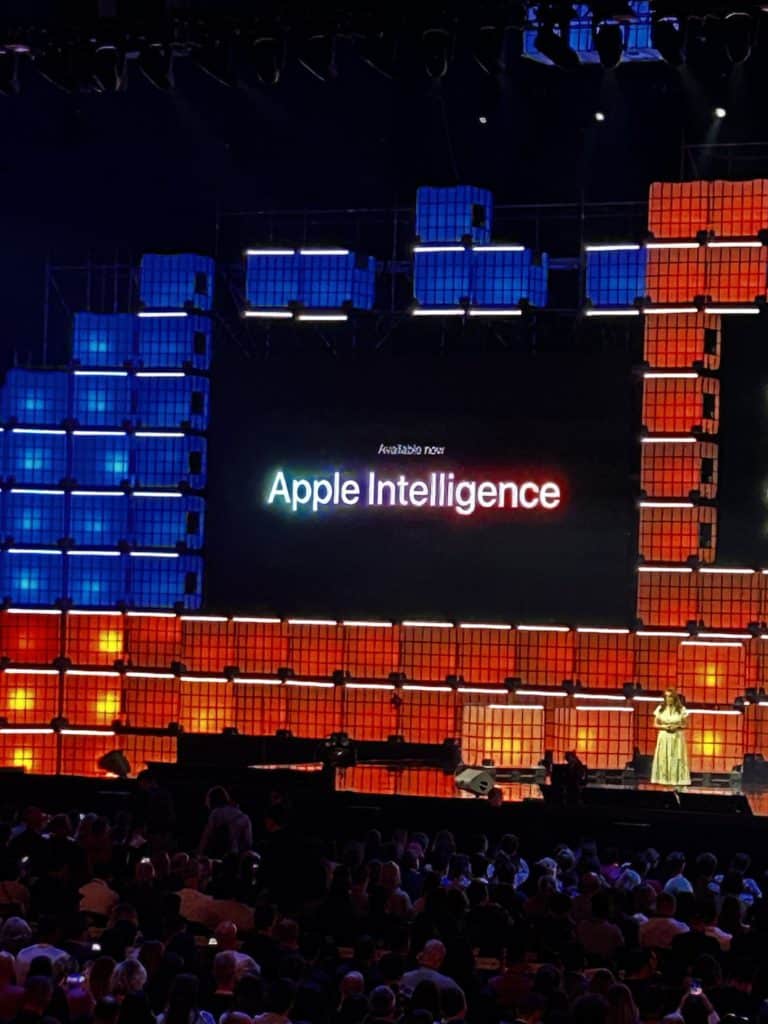
Here are the key points Apple has put in place in its accessibility design:
- They apply the same logic whatever the product: if someone knows how to use one product, they will know how to use all the others.
- Introduction of eye tracking and voice recognition
- Many advances make it possible to use the Apple Watch with one arm
- Introduction of the “Haptic Music” feature, which lets people feel music
Finally, a major new feature: with the AirPods Pro 2, Apple offers prevention and enables a clinically validated hearing test. They can also serve as hearing aids. Since these advances are accessible through devices that people already use every day, this constitutes a real accessibility initiative.
Go to the Accessibility settings on your iPhone to discover the latest innovations (don’t forget to update).
Media and AI
Talks by media leaders: Huffington Post, The Atlantic and The Independent
The main theme was, of course, the elections in the United States.
- We live in an era where traditional media are no longer people’s main sources of information.
- In the United States, for example, not everyone has access to reliable sources of information, which caused major problems during the elections.
- Media must reinvent themselves to stay at the forefront.
- Some media outlets are striking deals with AI companies (notably OpenAI).
It is impossible to ignore AI, so it is better to take part in this revolution. It can also bring potential revenue, whether from testing solutions or from training AI.
Training AI is also a crucial issue for the media, since it is important to train it on quality content in order to avoid disinformation.
To reinvent itself, the press must find other formats (audio podcasts, or others) and try new things to keep its place at the forefront, even if it is already almost (too) late.
Media must also find ways to write or present information that are not easily reproducible by AI.