
Who is behind the tool everyone is talking about?

“AI” stands for artificial intelligence.
One of the best-known companies in this sector, OpenAI creates and promotes very advanced artificial intelligence which it describes as “human-friendly“, benefiting all of humanity.
Before March 2019, OpenAI was recognized as a non-profit organization. Today it is a “capped-profit” company.
It aims to have a transformative effect by partnering with start-ups that use artificial reasoning, notably in care, health, climate change or education.
Its conviction: empowering people by helping them become more productive with AI tools.
Its products
GPT-2
Generative Pre-trained Transformer 2
It is an artificial intelligence capable of writing press articles and works of fiction.
GPT-2 works with a text generator that compares the words it receives to determine the most logical continuation and reproduces it in the same style. It is so effective that it becomes impossible to tell its text apart from one written by a human being.
Limitation: GPT-2 can become repetitive or absurd when it has to generate long passages.
GPT-3
It is the private beta version of GPT-2’s successor.
GPT-2 est doté de l’apprentissage automatique. C’est le champ d’étude de l’intelligence artificielle qui permet aux machines d’« apprendre » à partir de données, avec des modèles mathématiques.
This is how GPT-3 creates different types of content, such as stories, code, legal documents and even translations from a few input words. This version is even more powerful than GPT-2 and has 175 billion parameters, at least 10 times more than any comparable program up to then.
DALL-E
The name makes you think of a blend of Pixar’s robot WALL-E and the painter Salvador Dalí? It is an image generator derived from the GPT-3 model. It can create original images from text and even illustrate very abstract or whimsical concepts.
INSTRUCTGPT
It is a finely improved version of GPT-3’s language model. It is designed to follow human users’ intentions more closely. Answers to human requests are said to be more reliable, with fewer errors.
To do this, OpenAI called on a human team to evaluate GPT-3’s responses to instructions and rate them according to their quality and relevance. This is how a reward system was built into the reinforcement learning algorithm. This system then allowed InstructGPT to respond in the way humans appreciate.
InstructGPT models are now deployed as the default language models on the OpenAI API.
ChatGPT, the ultimate artificial intelligence!
Recently, the Internet has been shaken up by the new ChatGPT model, a model trained by OpenAI that interacts conversationally. ChatGPT is part of a series of versions around GPT-3.5 that showcase certain capabilities of the next model, GPT-4.
The difference from other models is ChatGPT’s ability to follow instructions more effectively. It is a sibling model of InstructGPT that can answer follow-up questions in detail and in dialogue form, admit its mistakes, challenge incorrect premises and reject inappropriate requests.
How does it work?
It is a learning model built on natural language processing algorithms to predict and generate text similar to human-written text. ChatGPT improves its predictions based on training data, using machine learning techniques.
It was in a training phase for several years and read nearly 500 billion words, the equivalent of more than 150 times the entire Wikipedia encyclopedia (in all languages).
It was programmed on one of the ten most powerful computers in the world, owned by Microsoft, which has around 10,000 graphics cards, almost ten times more than the Jean Zay supercomputer (the largest computer in French public research).
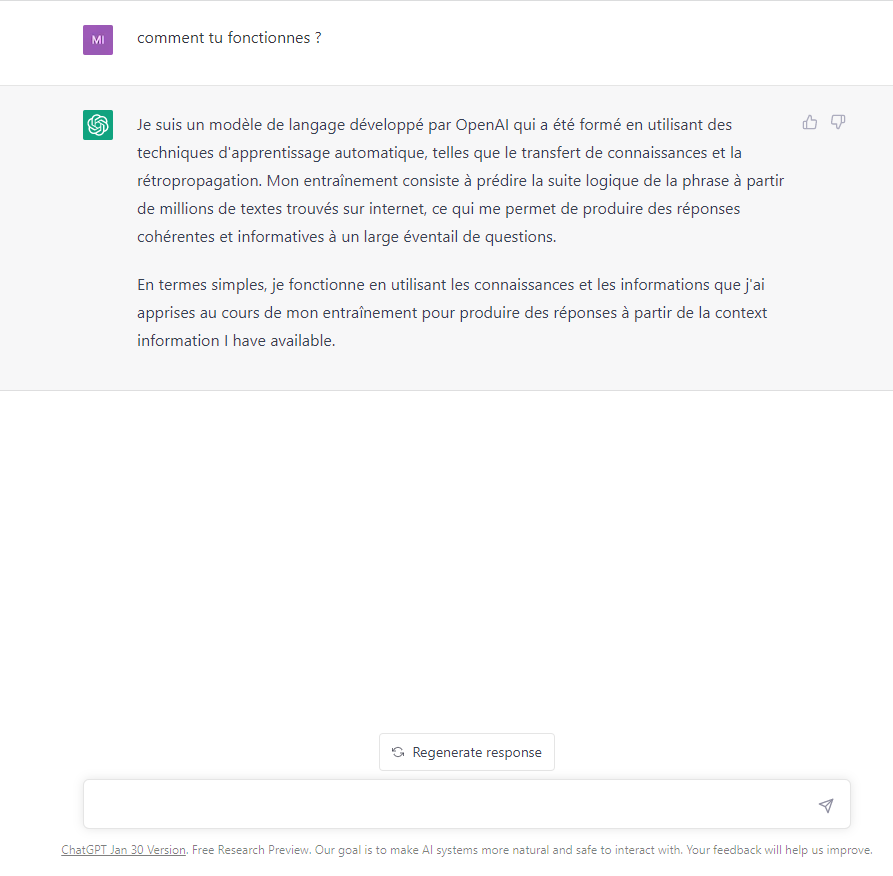
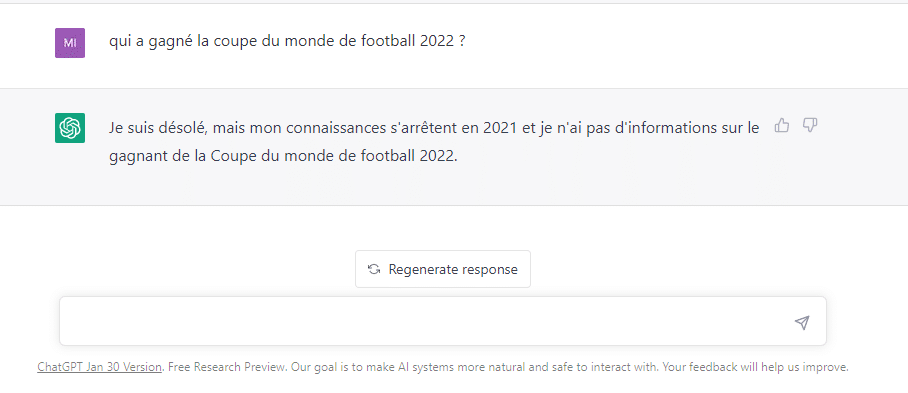
Its brain has not been fed since early 2022. ChatGPT has no idea what happened afterwards. Try it yourself: you will find that it lives in a world where Donald Trump is still President of the United States of America, and it does not know which team won the World Cup in Qatar.
So what can it be used for?
FOR AUTOMATED TESTS
Easy-to-understand code
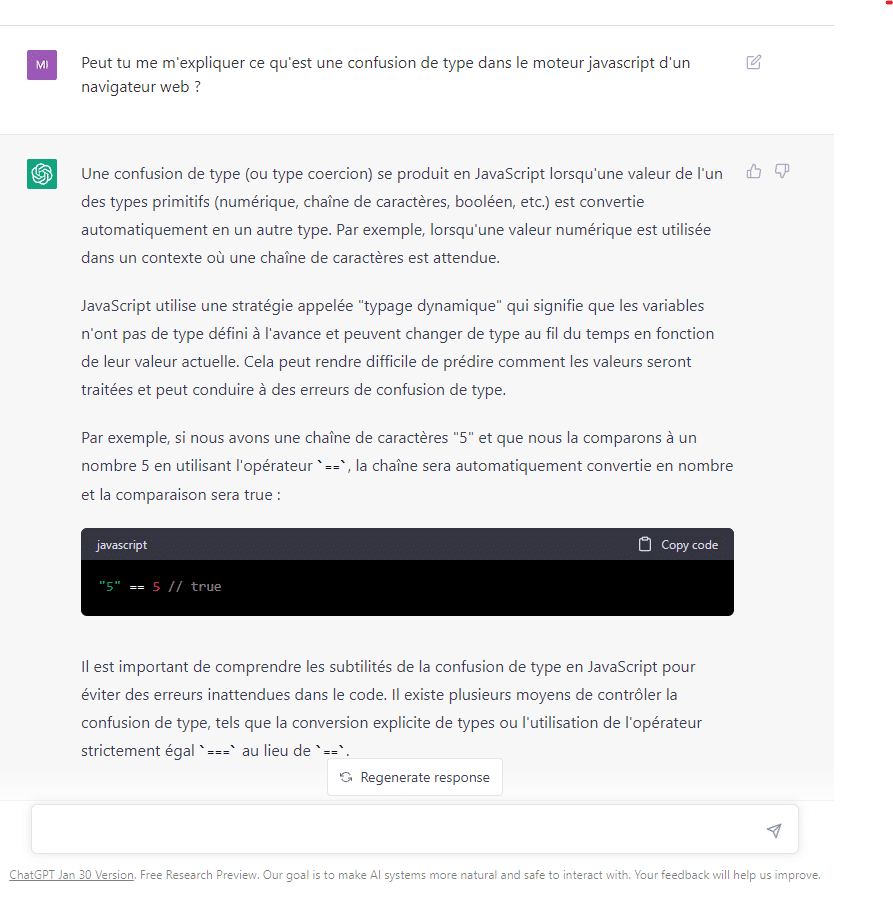
ChatGPT can generate code that is easy to understand, even for beginners. This is one of the main advantages described by code enthusiasts. To do this, it relies on simple, well-documented instructions explaining how to use the generated code.
This makes it easy for developers and testers to understand. They can even automate tests with this generated code without needing to understand how it works. A real time-saver!
Resilience and security
It is also possible to improve the quality of tests by adding resilience and security features, which are sometimes difficult to implement manually.
ChatGPT also helps overcome obstacles linked to knowledge of a particular technology or language. It generates code for popular automated testing frameworks, such as Selenium or Appium.
Code debugging
ChatGPT makes code debugging easier. It can analyze code and explain the error to provide an answer. This can save web developers precious time, particularly in the case of difficult bugs.
Limitation: it is not impossible that ChatGPT may sometimes miss steps or generate code with syntax errors.
FOR COMPANY CUSTOMER SERVICE
ChatGPT can generate effective automated responses to customers’ frequently asked questions. It is possible to train ChatGPT on examples of customer service conversations and then integrate it into an online chat system. It can thus reduce customer service requests and improve the user experience.
Limitation: ChatGPT does not have the ability to understand the nuances of language and human communication.
FOR SEO STRATEGIES
ChatGPT can improve marketing activities as a whole, particularly overall content strategies.
Web content creation
Content generation is the ChatGPT feature most used by marketers. It can write blog articles and product descriptions (and even poems). Artificial intelligence can help find content ideas, saving time and easing research efforts.
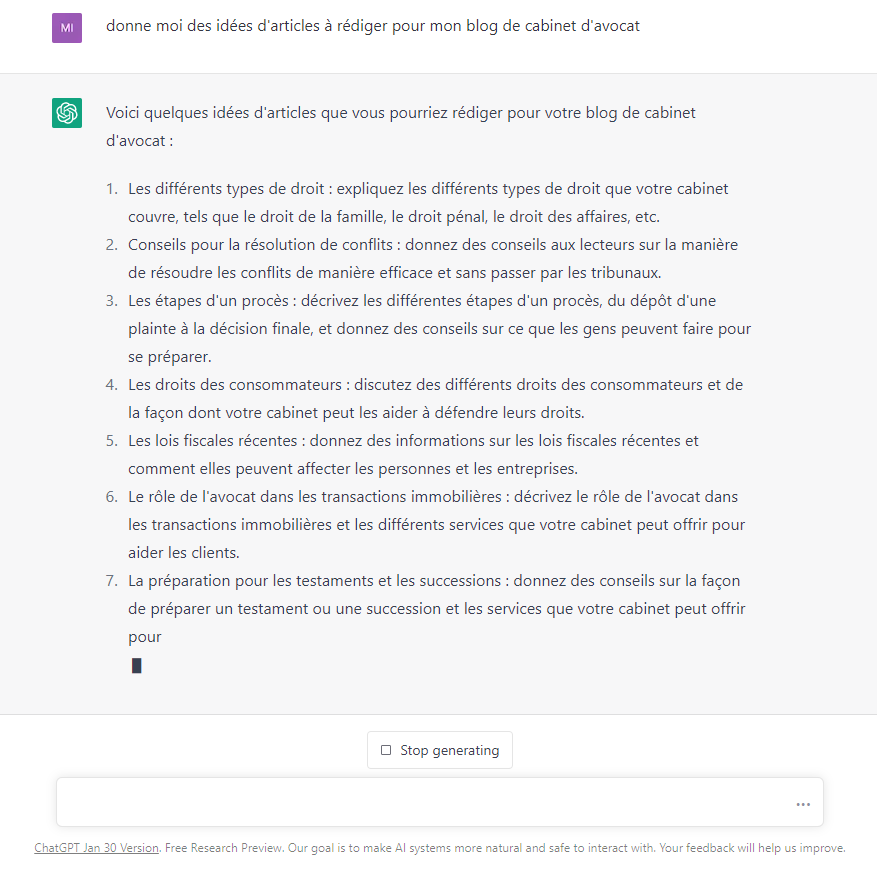
Limitation: ChatGPT can certainly suggest interesting ideas, but for content marketing to be relevant and effective, it is essential to offer unique content that stands out from competitors, is business-oriented and matches your sector and your values. It is a meticulous strategy in which every word is thought through in relation to the objective and, above all, oriented towards the prospect.
Social media content creation
ChatGPT can be useful for creating social media posts. It can come up with catchy headlines and post descriptions.
The communication agency habefast even says it used ChatGPT for its audiovisual studio Lakeprod to write scripts for dedicated videos. ChatGPT enabled them to generate scenario and dialogue ideas on which they built their next campaign.
SEO
It is also possible to optimize an SEO strategy through accelerated content production, thereby reducing the workload this entails.
By using short, specific texts, you can ask ChatGPT to generate blog articles, product pages, product descriptions or article titles optimized for search engines.
It can also suggest relevant keywords to improve the ranking of a piece of content.
ChatGPT could serve as a content production pipeline for improving local SEO.
Limitation: AI-generated content is considered spam by Google.
Professional copywriters still have a bright future ahead of them: the robot cannot replace unique, “human” content.
It is important to note that news about ChatGPT moves very fast. Things may still change.

The future of ChatGPT
ChatGPT worries Google
The launch of ChatGPT had triggered an alert at Google, which moved up a gear to develop an equivalent technology. The Mountain View firm announced, on Monday February 6, the launch of a competing conversational robot called « Bard ». Like ChatGPT, it will be able to answer questions by producing text that imitates human syntax. It is currently being tested and will be freely available within a few weeks.
However, at present, ChatGPT can hardly be used without checking the result against other sources. Its reliability does not allow it to be used as an everyday general search engine for information needs.
Today, 90% of the answers provided by ChatGPT are reliable. The 10% of errors mean the tool cannot always be trusted. It therefore cannot compete with Google for the time being.
But what stands out about ChatGPT is the form of its answers: long, structured, descriptive sentences with no spelling mistakes. This is what makes the tool promising, once the current errors are corrected. It may be a sign of how search engines will evolve in the coming years. (see our article on search engines)
2023 is likely to be a pivotal year in this respect.
We can expect Google to unveil new features soon, perhaps at the Google I/O event next May.
We can now wonder how SEO will adapt to this new standard, because adapting to these new evolving standards is likely to be significant, and not so easy…
ChatGPT interests Microsoft
According to The Information, Microsoft is already experimenting with ChatGPT technology, notably for Word, PowerPoint and its Outlook email. The company would like to develop the capabilities of its software and services ecosystem with this conversational artificial intelligence agent. It already has many ideas for using ChatGPT.
- It would make it possible to strengthen its search engine in competition with Google.
- It would also help Microsoft write emails and fill in Word documents.
Google has had “smart replies” in Gmail since 2015. They automatically fill in replies to emails with phrases inspired by the message received.
Limitation: these replies are basic and mainly limited to polite phrases and short suggestions such as “Got it!” or “Great idea”. Sometimes suggestions do not quite match the content of the email or the nature of the correspondent.
For Microsoft Outlook, ChatGPT would be able to generate fuller replies, emails of a few more elaborate lines than what Google offers, based on the history of exchanges.
Limitation: this would mean opening the correspondence to a text analysis utility, which would raise privacy and confidentiality issues.
- ChatGPT could also suggest expanding the reply, enriching it with a richer vocabulary, or suggest several replies depending on the tone you want to convey.
- It could also serve as a powerful search tool for finding an email or an attachment.
These ideas will now have to be put into practice. To do so, Microsoft will have to address not only privacy questions (also for the Office suite, particularly if sensitive documents are handled in this context) but also assess the quality of the output, because we now know that with ChatGPT it is mixed.

Want to put these levers at the service of your communication? h2a, communication agency in Luxembourg, supports you from strategy to creation.