
Google still well ahead, and by far
There is no question about it: its power is recognized and hard to challenge, notably thanks to advertising and the group’s impressive coverage: Maps, Waze, YouTube…
Google today holds more than 90% market share (92.23% in July 2022 in Europe).
But Google also knows how to promote its services, even if it comes at a certain cost.
Take the example of the agreement between Mozilla and Google: Mozilla and Google have just extended their commercial agreement, making Google the default search engine on the Firefox browser until 2023.
In Europe, Firefox represents 6.54% of the browser market (July 2022).
This agreement should bring Mozilla between 400 and 450 million dollars a year.
Google vs Bing, a perpetual duel?
Bing, the search engine created by Microsoft, is the eternal runner-up behind Google. The default search engine on Microsoft devices, Bing comes behind Google with a score of between 3% and 4% of the search engine market (3.3% worldwide, July 2022).
Bing is not alone: other engines use its algorithm, such as Ecosia and Yahoo!, which brings Bing to around 6% market share (in France).
What are the main differences between the Bing and Google engines? Here are the main criteria measured by the two search engines to index websites:
- Rich semantic field: what matters to Google is that the site contains a rich semantic field. The engine’s aim is to understand exactly what a user is searching for, in order to answer them as well as possible.
(In the long run, Google’s aim is to be an answer engine rather than a simple search engine: the use of keywords in searches is a thing of the past, and you can ask it a real question.)
- Core Web Vitals: web marketing blogs have published a great deal on this subject in recent months. Core Web Vitals simply groups together a website’s performance criteria: if your site is fast, responsive and easy to use, Google favours your ranking over a less optimized site. Combined with relevant content, your ranking can only improve.
- Backlinks (external links): the more links your site receives from other sites, the more it will be considered a reliable source by Google.
Overall, Google tends to behave like an artificial intelligence (even if this term remains to be defined precisely): in the end, what seems relevant to a human being will be relevant to Google, and optimizing a site for Google mainly requires common sense.
Bing
In general, Bing’s algorithm works the way Google’s did a few years ago.
- Keyword repetition: the more an expression or keyword is repeated on your site, the better it will rank on Bing for a given query.
- Metadata: Bing favours keywords contained in the site’s tags (title, H tags and meta description).
> These criteria used to be important for Google too, but Google is now able to understand the semantic meaning of searches and content, so it can give internet users genuinely relevant answers.
- Social networks: Bing favours websites linked to popular social network accounts (verified and recognized accounts).
From a digital marketing and site optimization standpoint, is it worth aiming for a ranking on Bing?
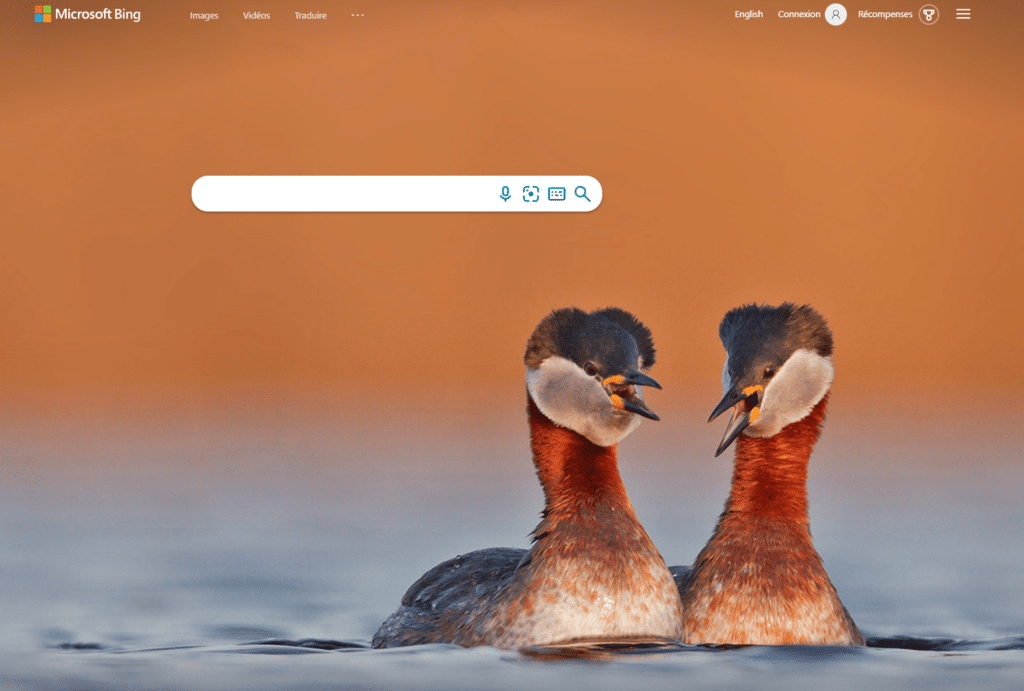
You may try to improve your ranking on Bing if your commercial target includes, for example, people who are not familiar with the web or not used to the digital world.
Experienced users tend to customize their default browser or use another search engine rather than Bing, whereas non-experts, not knowing how to change this setting, will keep Bing as their main search engine.

What are the new search engines worth?
The current trend is towards data protection and respect for privacy.
Google is particularly affected by this challenge, notably with regard to Google Analytics and advertising trackers, which make it possible to use internet users’ personal data for advertising purposes.
Protecting the environment and reducing energy consumption are also at the heart of discussions, and we are well aware that digital consumes a great deal of energy.
Let’s look in detail at two new European entrants to the market, both positioned as alternatives to Google, both in terms of respect for privacy and eco-responsibility.
Qwant
Created in 2011 in France, Qwant is the first European search engine to have its own indexing engine.
It is also the only search engine to offer a search engine for children (Qwant Junior).
What sets Qwant apart is that this engine stores no history and does not know who the internet users making searches on its service are: no advertising trackers or cookies, data is not kept, and it is completely anonymous.

This contrasts with Google, which keeps a history of all searches and also browsing cookies, used to send targeted advertising.
How is Qwant funded? The advertising spaces offered are selected in a traditional way: it is only contextual advertising, without storing search history and without using personal data.
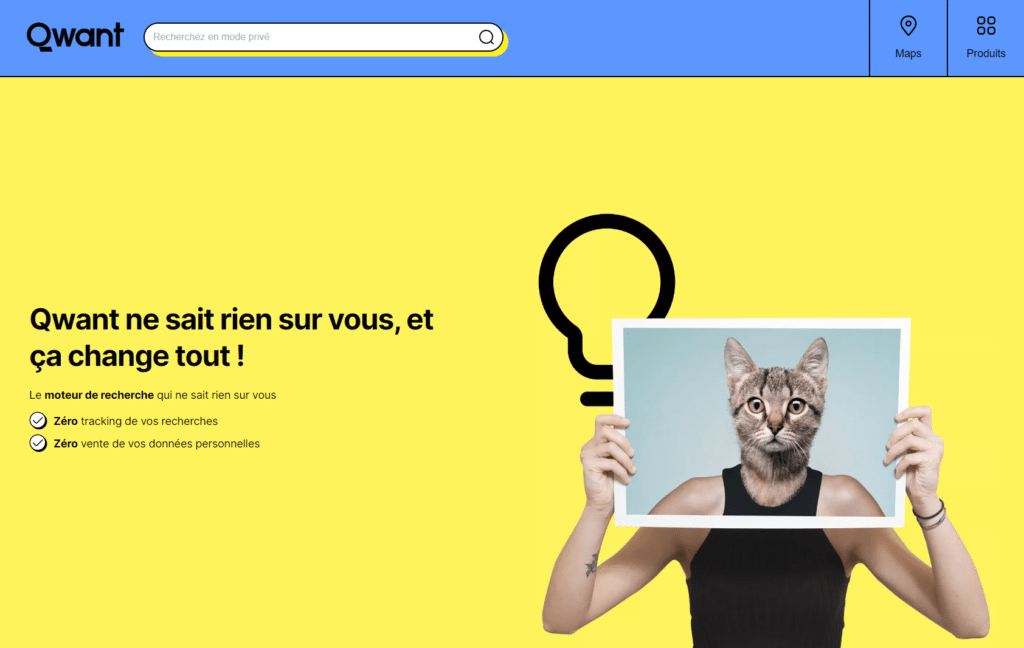
The watchword is therefore transparency and neutrality: all users receive the same results whatever their searches (no influence from advertising based on search habits).
A few figures:
6 million monthly users.
More than 7 million queries per day. Source: Médiamétrie, March 2021, France and international
Unlike Qwant, which built its own search engine, Ecosia uses Bing’s search engine (and therefore passes on part of its revenue to Microsoft).
The company’s business model guarantees that the founders can never take profits out of the company, nor even receive dividends.

Since 2014 the company has published its financial reports in order to guarantee full transparency.
Search engine market: Ecosia, a challenger to the tech giants
Ecosia’s main objective? Planting trees. To do this, Ecosia also sells advertising space (and guarantees respect for privacy) and uses all the profits generated by its revenues to plant trees around the world.
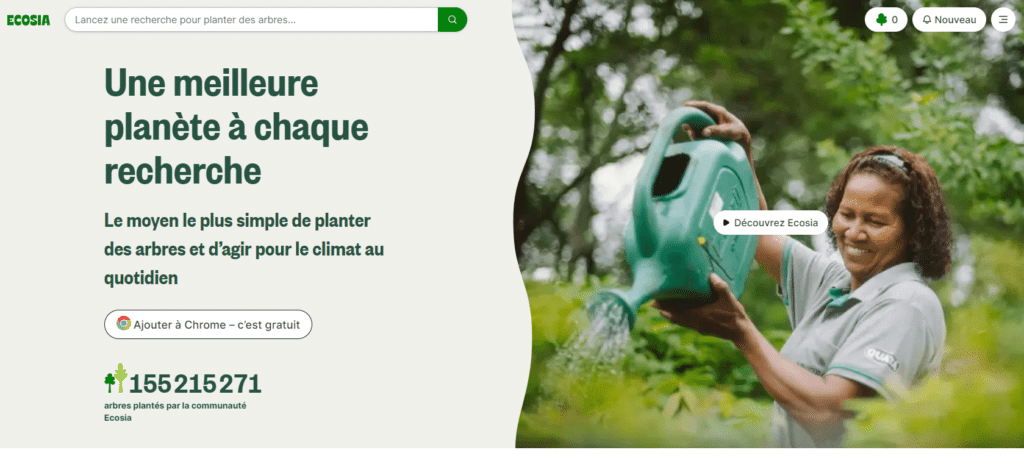
Ecosia is the first German company to have been certified B Corp thanks to its social business model.
A few figures:
20 million users worldwide
More than 155 million trees planted