Eco-friendly web is in the air. In recent years this subject has been making more and more noise. The various design disciplines are moving towards a more sustainable approach. This trend goes hand in hand with a growing awareness among governments, which are looking at the carbon footprint of digital technology and asking players and users to become more responsible, since the energy-hungry global Internet ecosystem is contributing more and more to global warming by imposing new systems.
“Digital activities are responsible for 4% of total CO2 emissions each year worldwide, a share that could rise to 8% by 2025.”
Rapport du groupe de réflexion The Shift Project publié en octobre 2018
In this article, we will look at eco-friendly web and explain how to build websites with a low environmental impact.
Growing awareness in the tech sector since the 2000s
For years, the subject of eco-responsible software has sparked much debate in the web industry, and many players have taken a position on it:

Depuis 2017 : Grâce à leur entité Google Energy, Google achète l’équivalent de 100% de l’électricité qu’ils consomment dans les énergies renouvelables.

2020: Microsoft announces its project to become carbon negative by 2030.
Apple sets itself the goal of becoming carbon neutral by the same date.

Facebook says it requires net-zero emissions from all its suppliers and users.
What is an eco-friendly website?
When can we speak of a green website?
An eco-friendly website, or “green website”, is optimized to have the lowest possible ecological impact. It is developed by taking into account the key principles of eco-design and by using all available resources to reduce the weight of its environmental footprint. Present at every stage of development, these principles apply to the entire life cycle of a website.
This means selecting content, selecting essential features, and optimizing media properly.
How can you tell whether a website is eco-responsible?
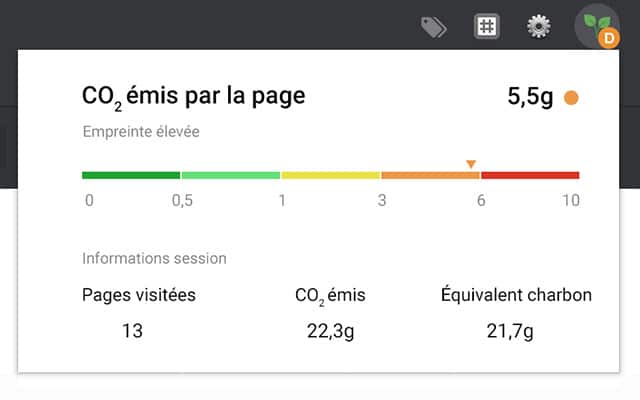
There are green website tools that make it possible to assess the eco-responsibility of a website.
- ecoindex.fr: shows the number of elements, server calls and the weight of a page.
- ecometer.org: flags the guidelines that are not respected among the 115 on which it is based.
- developers.google.com: the most comprehensive, it distinguishes performance on computer and on mobile.
- ecoconception.arneogroup.com: a sustainable tool
- Website Footprint: an extension that gives an overview of the impact of the page
- Page Speed Test: another PageSpeed tool that tests a large number of URLs automatically
These tools are effective for providing information on how environmentally friendly a site is and on the aspects to make more sustainable.
Why is it important for website creators to take this into account?

Improving SEO
When it comes to search engine optimization (SEO), eco-friendly, environmentally respectful website design can make all the difference. Lightweight, optimized sites more easily rank at the top of Google results and are specifically designed for searches.
An optimal user experience
An eco-friendly website gets rid of superfluous elements to focus on users’ essential needs, making their experience simpler and more pleasant.
Less cluttered, an eco-friendly website loads faster and performs better. A lighter site (with less script and repeated code, or with optimized code and scripts) is an efficient, clear and pleasant site to visit.
Longevity
Built to last, an eco-friendly website is easier to develop and to change in terms of design.
Developed with simple technology, these sites are less likely to suffer outages or bugs. An eco-friendly website is therefore easier to maintain over time.
An opportunity for brand image
Building an eco-responsible website makes it possible to be truly in line with the CSR approach of a company or local authority. As a communication tool, it is worthwhile for a brand to promote a less polluting website, in order to stand out from its competitors and build a good brand image with its target audience.
How do you eco-design a website? 6 good practices
To set up an eco-friendly website, or to carry out a more eco-responsible redesign, it is essential to take several actions.
Decluttering the content
Reducing the energy consumed by a website comes down, overall, to making it simpler. In other words, the digital product must focus on its core functions.
Care is needed here: choosing a minimalist approach does not mean creating a dull and unappealing website. It is essential to strike the right balance. It is simply a matter of justifying every detail of the product.
A perfect example of this approach is Google. Its home page is uncluttered and focuses on its main function: a simple and effective user experience.
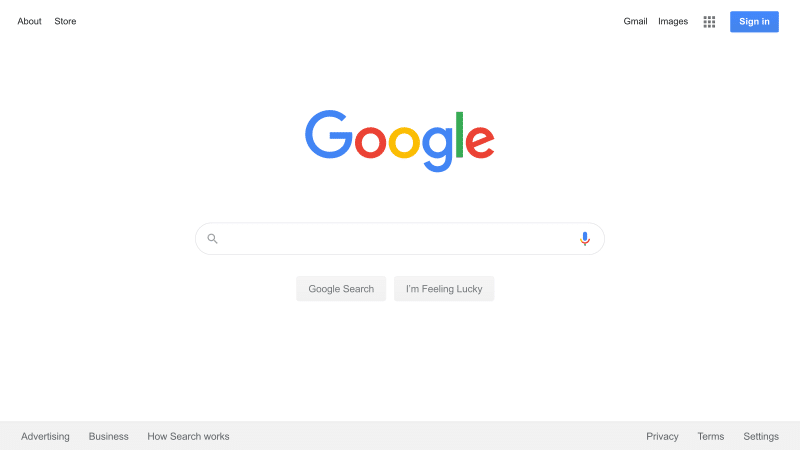
Most of the time, as a website develops over time, its content grows. The main cause of wasted electricity on websites is the storage of data that is no longer useful. This content tends not only to make websites overloaded, cumbersome and confusing, but also to saturate hard drives that consume electricity 24/7, which has a harmful effect on the environment.
Overall, the goal is to reduce as much as possible the number of words and pages on websites, and to focus on essential content, in order to obtain your eco-friendly website.
Improving the user experience
When a user clicks by mistake on a button or a menu, for example, a page will have been loaded for no reason. The more data a user loads, the more energy they consume and the more CO2 is released into the atmosphere. A redundant step in the user journey on a web page weighing on average 2 MB will have a real impact on the environment. The aim is therefore to avoid ambiguities in order to reduce these redundancies throughout the user journey.

Another polluting phenomenon: “yo-yo” user journeys.
This phenomenon occurs when users keep going back to a previous page in order to find their information. The most common case is when they return to the home page as a fallback in order to obtain information.
Note, however, that the amount of data loaded is much smaller when a user visits the same page several times than on the first load.
“Yo-yo” user journeys are therefore not the most environmentally damaging useless journeys, but they still have a harmful effect both on ecology and on users.
Optimizing files
File size
For most websites, images are among the elements with the greatest impact on carbon emissions.
“In June 2021, the median total weight of a website was 2,019 kilobytes (on mobile), and 881 of those kilobytes were images. That is more than HTML (30 KB), CSS (72 KB), JavaScript (461 KB) and fonts (97 KB) combined.”
HTTP Archive annual report on the state of the Web, 2022
Note that among the files that emit the most carbon, videos are the most consuming.

“From end to end of the chain (uploading, storage, viewing), video consumption accounts for 60% of all data flows broadcast and exchanged on the web, that is 300 million tonnes of CO2 per year, a carbon footprint comparable to Spain’s annual emissions, or “nearly 1% of global emissions”, according to The Shift Project.”
“ We live in a world where a single form of digital use, online video, generates 60% of global data flows and more than 300 million tonnes of CO2 per year.”
“Climate: the unsustainable use of online video” – The Shift Project – July 2019
It is therefore essential to use videos sparingly. Autoplay is in particular bad for the environment, but also for users with sensory disorders and motion sensitivity. It is recommended to place a play button in front of the videos on a website, to ensure they are only loaded by users who want to watch them.
It is also important to reduce the weight of these files. First of all, you need to choose the right formats. The choice of file format to embed on a website, WEBP, PNG, GIF or MP4, must be made according to the type of content and its purpose.
Using the most appropriate file formats is essential, but it may also be necessary to compress them. For this there is a large number of optimization tools. Among them, here are the most effective ones, which minimize file size without undesirable loss of image quality:
- Shortpixel
- TinyPNG
- ImageOptim
To obtain a site that leads to efficient file optimization, reducing the environmental impact of the website while improving the user experience.
Une collaboration active entre le client et l’agence conduit à une optimisation efficace des fichiers, réduisant ainsi l’impact environnemental du site web tout en améliorant l’expérience utilisateur.
Colors
Color plays an important role in the energy used by a website. Generally, the more color variation an image has, the larger it is. One way to limit the energy consumption of files is therefore to opt for images with reduced color variations, such as monochrome.
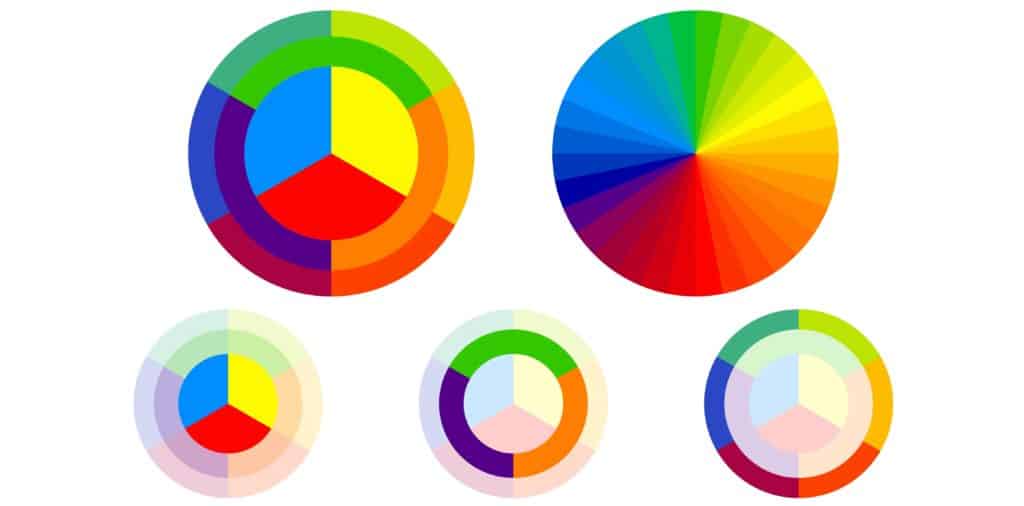
For some years now, OLED screen technology has become the standard for smartphones, laptops and smart TVs.
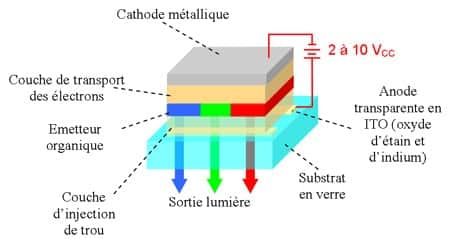
OLED is a technology that uses stacked diodes which, once powered by an electric current, emit their own light, unlike other display types such as liquid crystal screens that require a backlight. Each pixel of the screen consists of three juxtaposed diodes (blue, red and green).
Since each pixel thus becomes a tiny LED, using darker colors reduces the energy consumed by users’ devices.

It is recommended to favor:
- Black: the most efficient color for OLED screens, since the pixels themselves are switched off.
- Dark colors: they generally consume less energy.
- Green: it is one of the colors that emits the least.

It is better to avoid:
- White: the most energy-hungry color.
- Blue: it consumes about 25% more energy than green or red.
- Vivid colors: they have the greatest impact on the environment.
“Google Maps reduces the energy consumption of the screen by 63% thanks to its night mode”
Google – Android Dev Summit 2018
Finally, we should always ask ourselves whether using images is necessary. Is a photograph always the best way to communicate an idea? Can we achieve the same impact with other forms of styling if this can help us obtain an eco-friendly website?
Typography
Data transfers have a significant environmental impact. Some fonts increase this data transfer and the number of server requests needed to load a page. Lighter, simpler fonts can help reduce the load on the website, which reduces page loading time and the amount of energy required to load them. In addition, fonts designed to be easily read on different screens can also help reduce eye strain. Ultimately, by choosing a suitable typeface, web designers can help reduce the overall environmental impact of their website while improving the user experience.
Warning: it is important to choose the font while also keeping in mind the creative possibilities.
It is also worth optimizing font files. Many font generators, such as Squirrel’s Web, for example, make it possible to convert TTF format into WOFF2 to reduce file size without losing quality.
Green infrastructure
To design a more responsible website and reduce its ecological footprint, you should of course consider adopting green web hosting. Opting for a local host would be the best practice. Transmitting data across telecommunications networks requires energy, and the further the data travels, the more energy is consumed. The distance between the data centre and the website’s main user base can be considered as “megabyte miles”: the aim is for it to be as small as possible.
It can also be a web host that relies on servers powered by green and renewable energy. Here are a few examples of eco-friendly web hosts:
- Infomaniak
- Planethoster
- Ikoula
- Hostpapa
- Ionos (1&1)
Coding
Finally, writing code is not exempt from these rules. Here it is a matter of coding the website without using overloaded libraries and plugins that contain more features than necessary.

In general, as human beings, developers tend to add white spaces for readability, comments to help them understand, or intuitive names for classes and functions. These extras make the files larger than they need to be. It is therefore recommended to compress the code written to be readable by humans, to obtain a production-ready version optimized for machines. This purely machine-readable version of the code saves energy and improves web performance.
In order to guarantee the quality and sustainability of our websites, at h2a we develop our own plug-ins and our own custom templates, which allows us to precisely control the features and resources used. We only use external plug-ins when necessary, and only when we are convinced of their quality and their suitability for our needs.
We systematically adopt a “clean” coding approach that avoids any unnecessary overload, in order to ensure fast display and smooth operation of the website. This approach allows us to create high-performing and sustainable websites, which offer an optimal user experience while minimizing their environmental impact.
Is your company interested in eco-responsible websites? h2a is a competent agency
h2a is a communication agency that always keeps a close eye on developments in the web.
While we are of course committed to designing websites with attractive designs, we also think far beyond that: eco-responsibility, accessibility, standards… That is why we constantly keep up with the latest trends, new technologies and new standards. We are committed to designing responsible websites that respect the environment, security and accessibility, while meeting our clients’ needs. Our team of experienced professionals uses the latest technologies and best practices in sustainable development to create websites with a minimal impact on the planet.
We are proud to offer innovative solutions that combine performance, quality and respect for the environment. We believe that our commitment to these principles is reflected in the quality of our services, and we are proud to always offer the best to our clients. If you are looking for a competent agency to create your eco-responsible website, do not hesitate to contact us to discuss your project.
The klimapaktfirbetriber.lu website: a concrete example
The klimapaktfirbetriber.lu website is a concrete example of an eco-friendly website, implementing environmentally respectful practices to reduce its carbon footprint.
We put optimization techniques in place to reduce loading times and the amount of data transferred. This allows users to browse the site quickly and efficiently, while limiting the energy consumed to display it.
Lightweight technologies such as HTML and CSS were used. By avoiding complex, resource-hungry frameworks, we reduced the energy needed to run the site, while maintaining an optimal user experience.
We made sure to minimize the number of requests by grouping files together and optimizing the code. This limits the amount of energy needed to communicate between the server and the browser, thereby reducing the environmental impact.
The design was also thoughtfully conceived in an eco-responsible way, highlighting green and beige colors. These color choices are not only aesthetic but also ecological, since, as stated earlier, they are colors associated with low carbon emissions. In addition, the uncluttered design also contributes to the eco-friendly conception of the site by reducing superfluous elements, which limits the energy needed to display the site.
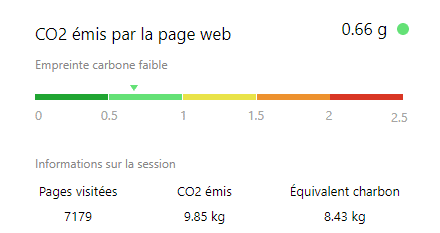
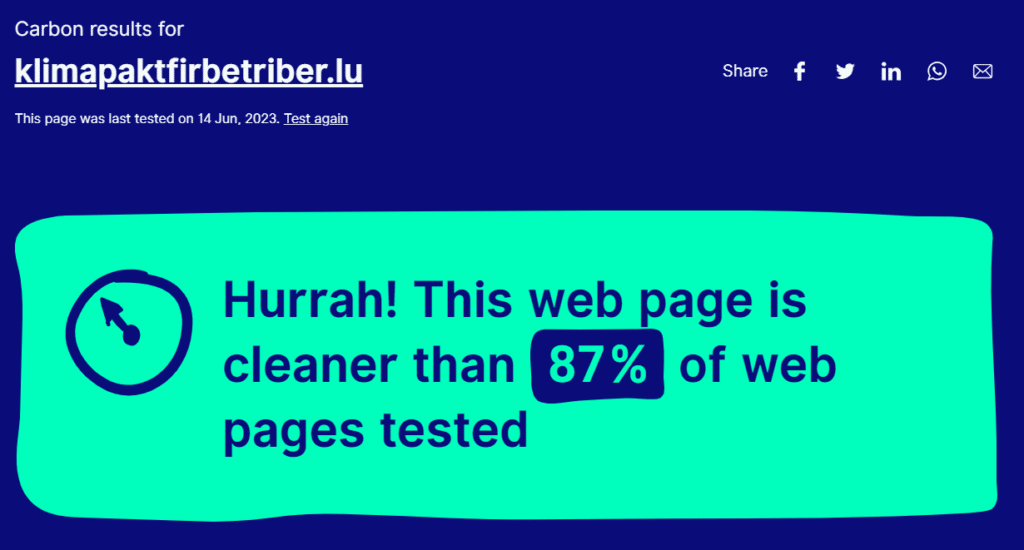
And the result is satisfying! The home page of klimapaktfirbetriber.lu emits only 0.66 g of carbon. Website Footprint rates its carbon footprint as “low”.
According to websitecarbon.com, this web page is cleaner than 87% of the web pages tested.