
Do you want to make your company known and build its reputation on the web? You think online advertising would be a good way to do it, but you are not sure how it works exactly?
[Chiffres mis à jour en 2024]
We invite you to read the 10 good reasons to launch yourself in our article dedicated to Google Ads, Google’s advertising platform.
What is Google Ads?
Google Ads is Google’s advertising platform (called Google AdWords until 2018).
Since 2000, this platform has allowed advertisers, businesses, agencies, or anyone wishing to make themselves known to the widest possible audience, to broadcast advertisements across all Google services, such as the search network, the display network, YouTube or Google Shopping.
Google’s advertising tool is one of the most powerful in the world, and there are many advantages to using it, whatever your need.
How does it work?
The subject may indeed seem a little vague from the outside, especially if you have never run digital campaigns before.
It should be understood that Google advertising is not launched at random: the aim is not simply to produce banners and broadcast them to as many people as possible.
We had already discussed this subject in our article on launching a social media campaign.
The first thing to do before launching a campaign (whatever its medium) is to decide on your objective. Why are you launching this campaign?
Without a precise idea and a defined goal, your campaigns will only deliver limited results, or at least not the results you hoped for.
Choosing your objective
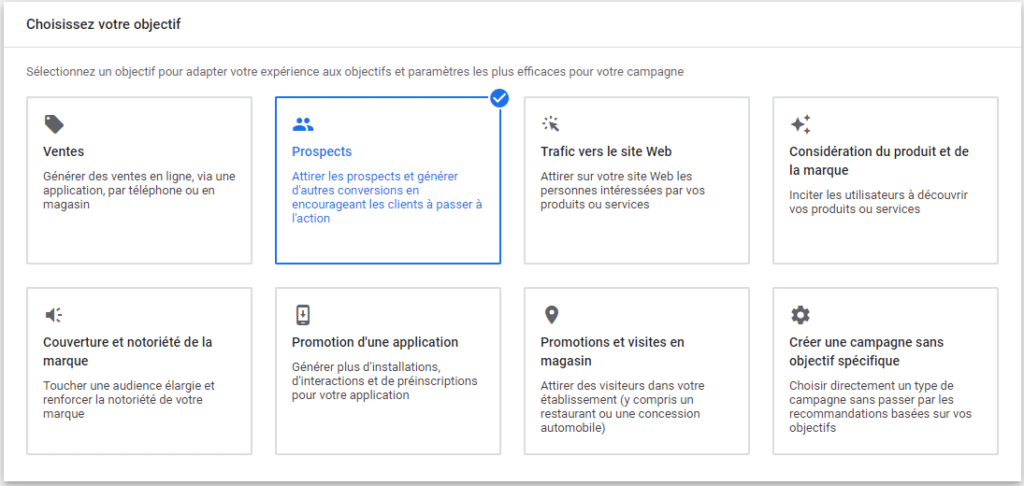
When creating your campaign, Google Ads asks you to select your objective:
- Are you looking for leads?
- Do you want to achieve e-commerce sales?
This objective will guide the entire strategy of the campaign, and Google will not offer you the same advertising formats depending on the objectives selected.
The objective corresponds to the final action taken by a visitor on your site, which directly generates an impact for you and therefore a “conversion”: this can be a sale made on your e-commerce site, a contact obtained via an online form, a visit to your site, and so on.
Depending on the objective defined at the outset, Google’s algorithm will steer your campaign to help you achieve your goals.
1. The power of Google

Google currently has a multitude of tools, each with millions of users. All of these tools can be used for advertising campaigns and therefore cover a significant share of the population present on the Internet.
For example:
- YouTube
- Gmail
- Google Maps
- Android
As we mentioned earlier in our article on Google Analytics 4, Google’s unique advantage is being able to track users whatever the medium used (mobile, tablet, TV, etc.), and also whatever Google tool is used (YouTube, Gmail, the Android smartphone OS, etc.).
2. The multitude of formats
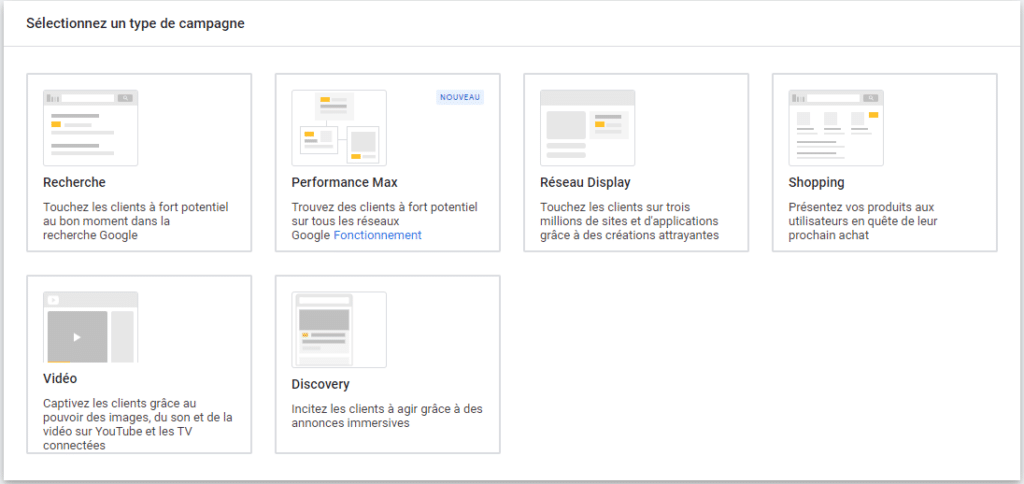
Depending on the campaign objective selected, Google Ads offers different advertising formats, each of which will help you achieve your goal.
For the “leads” objective, for example, you can opt for:
- A search network campaign: displaying ads according to the keywords typed by internet users in the search bar.
- A Display network campaign: displaying banners as the internet user browses, according to several targeting criteria that you define.
- A Google Shopping network campaign: if you sell products on a marketplace site.
- A video campaign: on YouTube.
The two formats below are less well known to the general public:
- A Discovery campaign
Broadcasting immersive banners on Gmail, Google Discover or YouTube.
These campaigns make it possible to target internet users precisely according to specific targeting criteria. As they draw on three Google tools, they achieve better results, whatever medium the internet user is using: mobile, desktop, TV. - A Performance Max campaign
Broadcasting banners and ads across all Google tools: YouTube, the Display network, the search network, Discover, Gmail, Maps, etc.
These campaigns involve a large degree of automation thanks to machine learning. They are delivered according to powerful signals based on your audience and your campaign objectives.
3. The number of users
Google has a large volume of users, across different media.
Here are a few figures as examples:
- Search network
Every day, 3.5 billion searches are carried out on Google. / 8.5 billion searches per day in 2024. - Network Display
It includes more than two million sites and reaches more than 90% of internet users worldwide.
Display campaigns can reach users across the world on 35 million websites and apps, as well as on Google-owned properties (YouTube and Gmail). - YouTube
Every day, 180 million hours are spent watching YouTube on television screens. / In 2024, YouTube users collectively watch more than one billion hours of content every day on their TVs.

4. You pay according to the result obtained
Depending on your campaign objective, Google will not charge you in the same way:
- If you want to increase awareness, you may be charged a cost per thousand views of your advertisement.
> This makes it possible to display the advertisement to as many people as possible and to pay for every 1,000 views. The algorithm then directs the advertisement to reach as many people as possible. - If you want to increase traffic to your site, you will be charged a cost per click on your advertisement.
> This makes it possible to show your ad to the people most likely to click on the link. Unlike cost per thousand, the algorithm looks for visitors who are genuinely interested in the content of your site. - If you want to obtain purchases or leads, you can choose to be charged a cost per acquisition of a customer.
> In this case, the algorithm looks for people interested in the service offered, with the aim of attracting qualified leads.
You can therefore control your budget and spend money only on what really matters to you: getting sales, gaining traffic or gaining visibility.
5. Measurable results
Unlike some types of traditional campaigns, digital campaigns allow you to measure effectively the objectives achieved.
Thanks to the measurement tools offered by Google, you can effectively track the user journey and measure the leads and visits received and their impact on your business.
The impression of “fuzziness” or lack of mastery that one may initially feel with digital, unlike the traditional media that have been known for a long time, is very easily offset by this practical aspect of control and cost measurement.
You can end your campaign knowing how much you spent on acquisition, how many visitors/leads you obtained, and how many were ultimately converted into sales.
6. It is quick to set up and adjustable
Unlike a TV campaign or a more traditional campaign, once a web campaign is launched, it can very quickly reach its target.
A cinema campaign can only reach its target if the person goes to the cinema.
A Google Ads campaign can reach its target at any time on mobile, desktop or TV (YouTube on TV).
Another advantage is that you can preview your campaign when creating it, which means that if a visual or a wording does not have the expected impact, you can still modify it, even after the campaign has launched.
7. It is effective!

More figures, always more figures, but they give a good idea of the colossal volume spent on advertising budgets.
Google figures for the third quarter of 2020:
- Revenue: $46.2 billion (+14%)
- Net profit: $11.2 billion (+59%)
- YouTube ads: $5 billion (+$1.2 billion)
Google figures for the third quarter of 2024:
- Revenue: $88.3 billion (+15% year on year).
- Net profit: $26.3 billion (+34% year on year).
- YouTube ads: $31.51 billion in 2023.
Another interesting statistic shows how important YouTube has become as an information medium:
More than 40% of buyers worldwide say they have bought products discovered on YouTube.
Industry professionals have also pointed to internet users’ habits. Unlike traditional media, users of platforms such as YouTube go there to watch videos they have selected: they are therefore at their highest level of attention, as opposed to people who switch on their television for a “presence” or while doing something else.
On YouTube, everyone has their own “personal prime time“, which does not depend on a time imposed by the broadcaster.
- A person on public transport will enjoy their personal moment at 7 a.m.,
- while another user at home will prefer to watch videos at 10 p.m.
Either way, both are at their peak of attention at the moment they choose. If both are part of your target, they will be receptive to your message, whatever the time. This differs from a TV advertisement broadcast during peak viewing hours, which is not necessarily the time when viewers are most receptive.
8. Your target is necessarily present on the web
According to Médiamétrie, in France, as of 2021:
- 92% of French households have access to the Internet
- 53.5 million individuals connect to the Internet each month
- 67% of our time spent on the Internet is on mobile
- 2h26 is the time spent on the Internet
NOTE
- 62,5 % de la population mondiale utilise Internet
- 67,1 % de la population mondiale utilise un mobile
- 4,62 milliards d’utilisateurs actifs des réseaux sociaux
Selon Médiamétrie, en France, en date de 2024 :
- 93 % des foyers ont accès à Internet
- 56.6 million individuals connect each month
- 2h57 is the time spent per day on the Internet, with mobile accounting for 80% of that browsing time
According to We Are Social / Hootsuite, in 2024:
- 67.5% of the world’s population uses the Internet
- 70.3% of the world’s population uses a mobile phone
- 5.22 billion active users of social networks
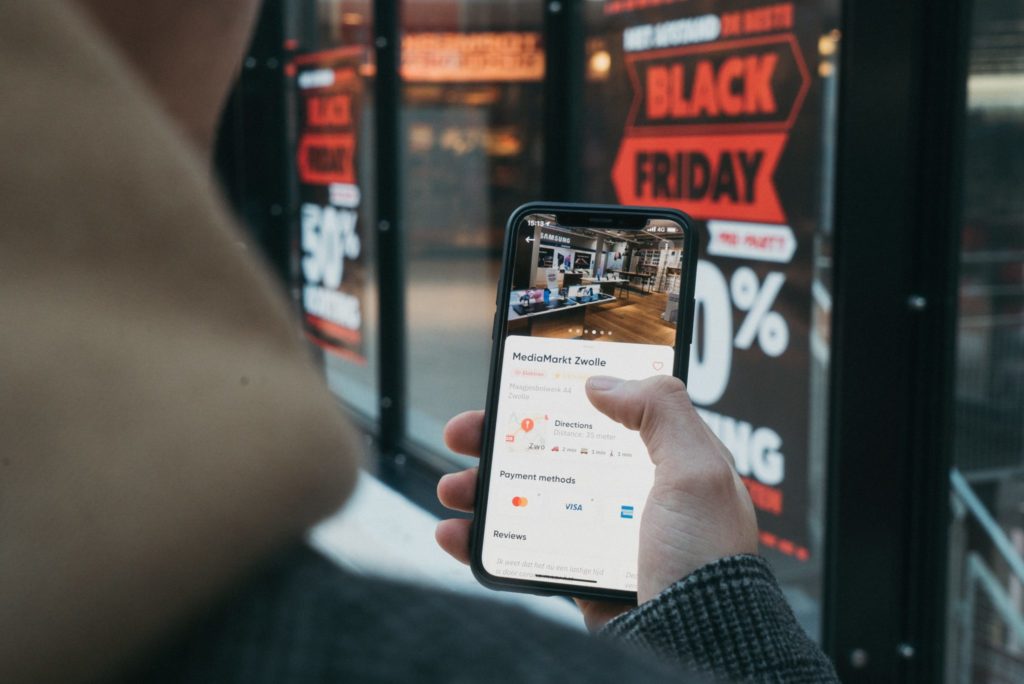
It is time to go and find your customers where they are!
9. Constant evolution
The Google platform is constantly evolving, notably by using artificial intelligence, which allows greater responsiveness and greater precision.
In addition, new advertising formats are very often introduced to adapt to the different types of devices available on the market: TV, mobile, desktop, etc.
10. You are not alone!
Convinced and want to launch Google Ads campaigns?