
We are continuing our series of articles on social media, this time tackling Facebook. Together we will see how to use this social network in a practical and useful way for a business.
1. An overview of Facebook
Since its creation in 2004 in the corridors of Harvard, Facebook has become such a powerful machine that it can make or break reputations in every field: politics, business and audience manipulation.
How do you carve out your place in the sun on Facebook, knowing that millions of people are there, and almost as many companies?
The Facebook page
Your company’s Facebook page (and not your personal profile) lets you enter practical information about your business:
- Geographic location
- Opening hours
- Description
- Photos
- Job vacancies
- Published posts
The more content you add to your page, the easier it will be for visitors to find you on Facebook.
Why be present on Facebook?
This social network, the first to really bring together all ages and all cultures, has become part of everyday life since 2004. It is no longer a fashion phenomenon: Facebook is a habit, a means of communication like any other.
Everyone is on Facebook.
2. Which audience?
Today, in 2020, Facebook has 2.603 billion monthly active users.
Who?
The Facebook audience is very mixed, unlike other social networks that attract specific categories of people.
Take the example of a family in which every member is registered on Facebook. They all want to stay in touch and interact with each other and with their friends, but let us also look further:
- They can use Messenger together as a family
- The younger ones can follow their favourite music groups
- The older ones can get back in touch with old friends they have found on the network
- Teenagers and young adults can use it to stay in touch with childhood friends who have moved away
- Parents of young children can use it to follow cooking blogs or communities of parents from their children’s school.
- Everyone can follow blogs, shows or artists
This family is itself a community, and each of its members uses the network to stay in touch with their own community: young parents, seniors, teenagers, former pupils of a secondary school, and so on. Each individual weaves their own community around their interests.
Each person builds their own social universe over the course of their life and their encounters, so Facebook is an entire galaxy of small universes.
Stephen Wolfram, a mathematician, developed an algorithm that makes it possible to study each person’s relationships and turn them into a sociogram (this tool can be used on Facebook if you are tempted by the experience).
Here, for example, is what this representation looks like for a young American woman:
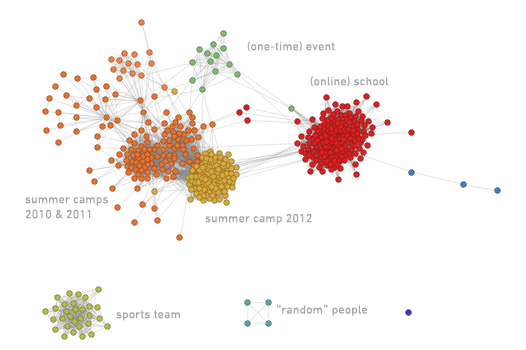
We can see clusters, also called groups, which represent the different communities she frequents or has frequented: school, holiday camps, a sports club and isolated people met over time.
Facebook, unlike the LinkedIn social network we discussed a few weeks ago, is a social entity: it allows the members of a community to interact with one another.
The world meets on Facebook and organizes itself into communities, unlike other social networks, which have generally been designed for only one type of person.
So it is up to you, with your company page, to build your own community of customers, followers and professional contacts.
How?
- Multiple communities
Several options are open to you for building your community:
- Publish content regularly
- Inform your followers about what you produce: how it can meet their needs
- Share information about your company’s life
- Keep listening to their needs and reply to the comments you receive
A Messenger account is linked to your page, which allows users to contact you through it. You can also reply to comments on your posts directly in this messaging service, for a personalized answer.
- Do you know your followers?
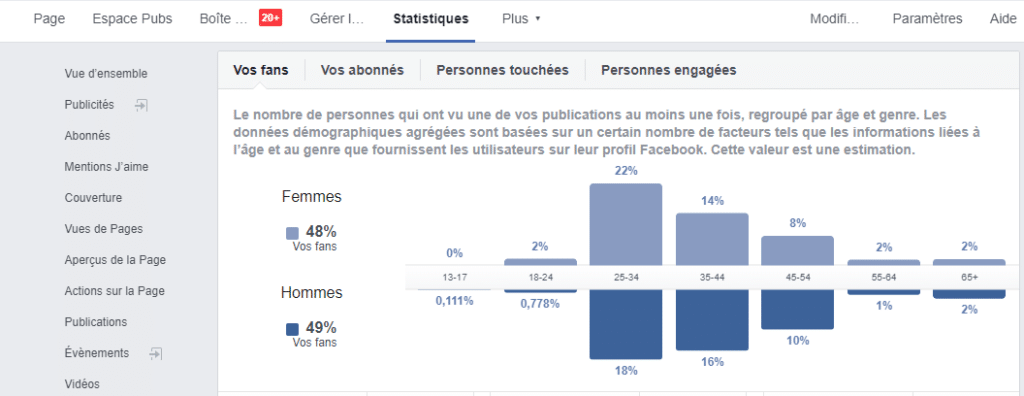
You can go to the statistics section of your page to view your results: number of likes, people following you, and many other useful statistics.
This statistics section will also tell you more about your followers’ profiles: their age, where they come from and their language.
- Facebook is still at the top
We have often heard recently that Facebook was losing momentum. Yet the figures show that in 2020, 500,000 new profiles were created on Facebook every day, that is 6 per second. The average person spends 35 minutes a day on Facebook.
All the more so since the lockdown we have just been through, Facebook’s traffic figures have been constantly increasing. Facebook being in the end the virtual representation of your social circle, it was only natural that during lockdown the “virtual life” would take over. Through Facebook, many social relationships could be maintained at a distance.
3. Details on the algorithm
The Facebook algorithm is constantly evolving
The Facebook news feed is a clever combination of several elements: the posts in your feed are displayed neither in chronological order nor at random; the order is determined by how you use the network:
- Based on your likes: the brands and pages you have liked will be shown to you first
- Your “close” friends: the friends you interact with most will be the ones whose news is shown to you first. Facebook looks at tags in photos and comments and therefore determines your “closest” friends. These are not necessarily your real close friends in your life.
You may have hundreds of friends and liked pages, and you will not systematically see all the new content in your network.

The user finds themselves enclosed in their “circle” of friends and pages they like: they thus create their own world, which they know well, and this encourages them to come back.
This can be a danger for the user, since they no longer have a global view of the news. Very often, it is within these circles that fake news develops.
These closed circles of users force brands to pay in order to reach as many people as possible with their content. Your preferences and habits of use determine the advertisements shown to you in your news feed.
Surveys of internet users are carried out regularly, allowing the managers of the social network to stay informed about users’ wishes.
How do you create an impactful post?
- Short and precise posts
People must understand your idea immediately, without having to read your article. Questions are a good way to generate engagement.
- Using videos
Videos make it easy to generate engagement on your posts, thanks to their dynamic content. Be careful, however: nowadays, 85% of videos are watched on Facebook without sound. Videos with subtitles should therefore be favoured for users who cannot watch Facebook with the sound on.
- Using images
Images express a strong idea quickly and therefore catch the eye.
The goal for your page is to get reactions and comments. Without them, your post will very quickly be forgotten and lost in the crowd.
4. Content marketing applied to Facebook
Even though some users consider it a reliable source of information, personally or professionally, this does not match a European target. However, it should be noted that 45% of Americans say they get their news from Facebook.

Most Facebook users use it as a pastime: they follow posts from their loved ones, friends, blogs and, for some, newspapers.
This is where your page statistics can tell you more about your target: you can thus determine which category your followers belong to.
“Snack content“
Content published on Facebook is very often in the form of “snack content“: content to be “nibbled”. The platform is consulted occasionally: while waiting on public transport, in a waiting room or between two business appointments.
It is therefore important to respect this guideline of easy, light content, even if the idea in your post is important.
If you have an idea or content that could be the subject of an in-depth article, you can keep it for your blog and share a fuller post on LinkedIn; on Facebook, however, you may only share part of the idea: tackle only the main idea or a more appealing angle.
As discussed in our last article: your blog is your main medium, where you can write your content in “large format”; you then adapt your posts by “breaking up” your content according to the target of each social network.