At this particular time, communication is more crucial than ever. It helps ensure that society can continue to function, that businesses can keep working safely, and that individuals can look after one another while remaining at a distance.
Social media to stay connected
The world has changed its habits very quickly and the whole economy has been upended. This is an exceptional fact, since wherever you are at the moment, the world around you has changed and everyone has to adapt the way they work and live in order to survive.
Today, digital occupies a decisive place: it is what allows us to stay in touch with the outside world. You may have heard or read that platforms such as Netflix reduced the quality of their videos so as not to saturate the network. That shows how connected the world is and how much it “consumes” web content.
A worldwide study by Kantar, carried out during the pandemic, reveals that web browsing has increased by 70%. Communication networks such as Facebook, WhatsApp and others display impressive usage figures.
Read the article
An article written by Joanna Stern in The Wall Street Journal last March 21 is titled: “OK, Fine, Let’s All Get Back on Facebook” (Okay, fine, let’s all go back to Facebook), and describes how many people have rejoined Facebook in recent days. Mark Zuckerberg’s network had nonetheless been losing momentum for some time, with waves of mass account deletions recorded. But internet users quickly realized that they needed to find a place where we could all stay in touch with one another without physical contact. As it happens, that place already exists: it is what Facebook created.
Read the article
Even companies that had never introduced remote working before, or that had never fully taken the digital plunge, are continuing to provide their services at a distance. Digital offers quick and effective solutions in the short term.
Your internal communication is fundamental
Beyond the security rules and the necessary lockdown measures, for service companies the main priority is to continue their work and keep serving their clients. Internal organization is decisive for this:
- How do you keep communicating?
- How do you keep managing business?
This is now when digital becomes a genuinely crucial tool for business continuity.
Let us tell you about our current situation at h2a
For several years we have been using the online tools Dropbox, Skype, Fitnet and Monday. In normal times, these solutions already allow us to work from any workstation, and from anywhere, as long as we have an internet connection.
Of course, physical meetings and live collaborative work are essential parts of our daily life: they allow us to express our ideas and be more efficient.

Dropbox
We use the business version of Dropbox, which lets us store all our files online, making them accessible to all team members. Dropbox also has a multitude of practical and indispensable features that save us a great deal of time every day (Gsuite, Paper, secure file sharing with external parties, etc.). Another advantage is that there is no server maintenance and no backup problem 😉
Learn more

Skype
A very well-known tool, it lets you chat, make calls or hold video conferences. It is now also possible to call telephone numbers, and a Skype Business version exists for companies. We usually use it within the team as a simple chat, but at the moment it allows us to hold team video conferences, as well as with our clients.
Learn more
Fitnet Manager
Fitnet Manager is a sales and administrative management tool. We therefore have access to all essential documents (purchase orders, client contacts, invoices, etc.). It is a real time-saver, since all our documents can be digitized and shared by everyone.
Learn more

Monday
This is a project management tool that enables collaborative work, information sharing and the organization of these projects over time.
The team shares its documents, its briefs, the status of its tasks, the deadlines, and everything is accessible in one place at a single glance. We can know the status of any project in real time. Thanks to Monday, we save precious time, since it lets us focus on important tasks instead of losing time organizing them.
Learn more
Despite a slowed-down activity, working remotely does not fundamentally change our tasks.
These four online software tools allow us to manage our various projects more efficiently on a daily basis: they help us avoid using paper, share information with teams immediately, be more responsive to clients, and not lose time even when we have to travel for appointments or any other reason. Simply having an internet connection is enough to connect us to our tools.
Inform your clients of your situation
In the Kantar study, a clear majority of consumers expect advertising to make a positive contribution to society, and 75% expect companies to keep informing them about their efforts to deal with the situation.
Your clients are currently spending a lot of time on the web or on social networks, so it is essential for you to inform them and occupy this space to share what you are putting in place to ensure your work continues.
You can create an email campaign, post a message on your Facebook or LinkedIn page, update your Google Business Profile, or publish an article on your website. The main thing is to stay in touch.
Most service companies are keeping their business going despite the crisis: banks, estate agents, developers, business services, etc.
Even though construction sites are at a standstill, business goes on: reviewing plans, advice and property valuations are entirely possible at this time. Companies are organizing themselves to make the most of digital tools and thus maintain their activity at a distance.
Positive communication and solidarity
Given the shortage of protective equipment and the difficult conditions in which healthcare staff, doctors and everyone else on the front line of the epidemic are working, a wave of solidarity has emerged in many companies.
Several of them have made their production tools or their know-how available to help the community.
Here are a few examples we came across in the press (this is not an exhaustive list, and we apologize for that; we take this opportunity to salute all the initiatives that have emerged over the last few weeks):
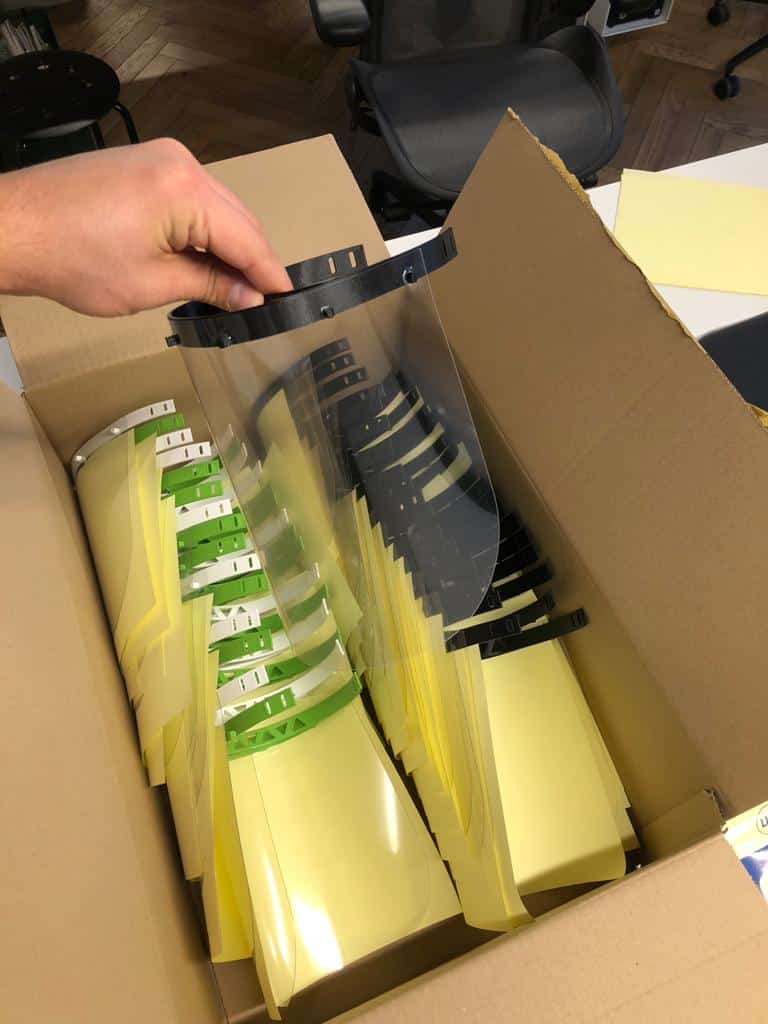
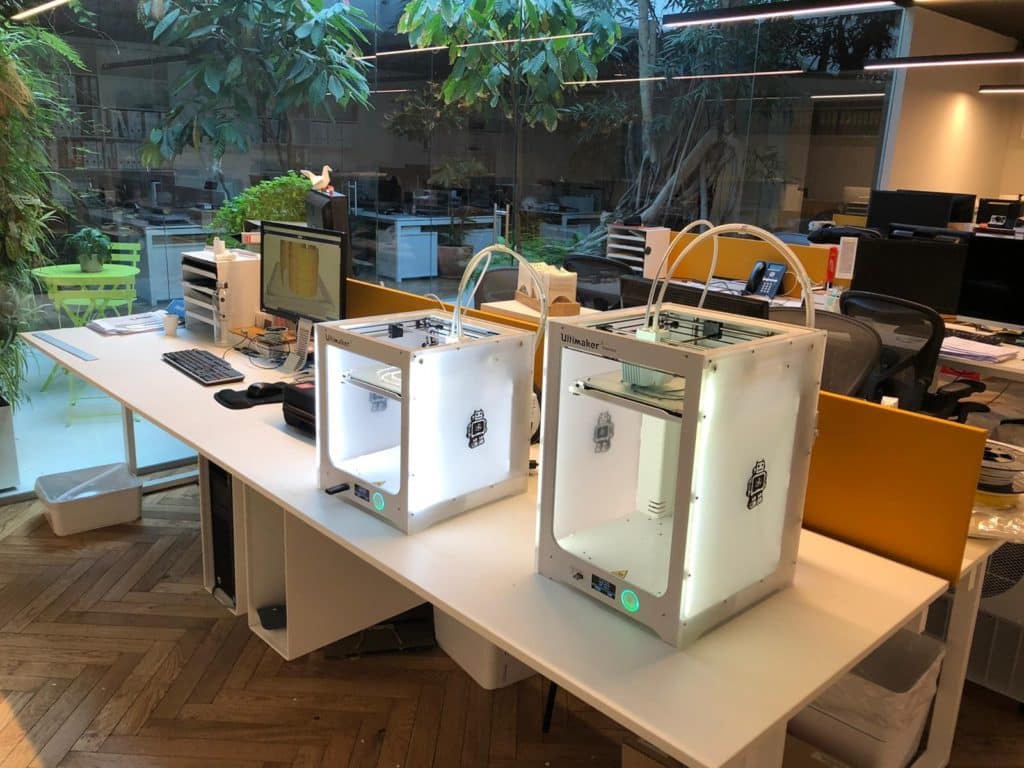
Metaform architects created a file to print face protection masks on a 3D printer
In this way a whole network of printing and mask production has been organized, and the masks are now collected by the army. Volunteer individuals can join the operation.
See their Facebook page
Luxvisual joined this same wave of solidarity and produced the protective visors that are attached to these masks
The company also published a statement on its website to announce that it is making its production tools available to the community.
See their website
Production of disinfectant solution
The Luxembourg cider producer Ramborn is producing bottles of disinfectant solution and distributing them free of charge to institutions and shops in the neighbouring municipality.
Read the Paperjam article
Digital Aid Program
Launched by Regie.lu and the Chamber of Commerce of Luxembourg
This programme allows companies or entities whose products and services are essential to the smooth running of Luxembourg’s economy and the life of its residents to obtain visibility free of charge in several Luxembourgish online publications.
Learn more

Although these actions have no commercial interest, it is essential to talk about them and make them known. If your company has taken part in actions of this kind, rest assured that it will emerge from them stronger, in many respects.
The sense of belonging that your employees feel will be considerable, because they will feel useful within the community. They are the first ambassadors of your brand or company: they will share this experience with their loved ones and on their social networks, which will increase your visibility.
Even though the trend has already been evolving, the crisis we are going through will, we hope, radically change our habits, the way we consume and the way we exchange. Responsible and committed purchasing will take on a very different role, and customers will turn more towards companies that act for the good of the community.
Towards new habits?
What will we remember of these weeks spent at home in the future?
It is likely that new solutions will emerge following the “forced” introduction of these emergency measures.
In the end, what matters for a company may not simply be being present in one physical place, but above all being available everywhere, online.
We will understand that digital is not simply entertainment, but that it can genuinely serve our businesses and make us more effective in our work.
Finally, let us hope that the movements of solidarity and mutual aid will continue even in a healthy society.