
[Updated in 2025]
Between tracking, advertising, cookies, trackers and pixels, and the many tools for capturing data, websites are one of the main sources of risk to privacy.
Since May 25, 2018, website creation has been governed by the GDPR, the General Data Protection Regulation. In the age of Big Data, this European regulation, which applies identically in all EU countries, is an essential step in protecting internet users’ data.
Do you collect and/or process the data of natural persons domiciled in the European Union? Then you are concerned by the GDPR, even if your company is not itself based in the European Union!
So what are the principles of the GDPR? Why take them into account when building a website? Where do we stand in 2025? How do you make your site GDPR friendly? We explain everything in this article!
Where do we stand on the GDPR in 2025?
Evolution of consent and cookie walls (2024)
Since 2024, cookie walls have been increasingly regulated. The GDPR now requires that consent be genuinely free: blocking access to a site when the user refuses cookies is no longer considered valid, unless a fair alternative is offered.
Companies must review their cookie banners and offer a real choice without pressure.
To learn more about cookies, click here.
New EDPB position on “consent or pay”
The EDPB (European Data Protection Board) clarified its position in 2024 on the “consent or pay” model. Charging for access to a service in order to avoid targeted advertising may be lawful, but the choice must be fair and non-manipulative.
Companies must assess whether the fee proposed is reasonable and whether refusing consent does not unfairly disadvantage the user.
European Commission decision: Switzerland, an adequate country (January 2024)
In January 2024, the European Commission confirmed that Switzerland is an adequate country within the meaning of the GDPR. This means that personal data can be transferred to Switzerland without additional contractual clauses.
For Luxembourg companies working with Swiss partners, this is an important legal simplification.
Updates on portability, data protection by default and reinforced obligations
Since 2023, the GDPR has focused on three key aspects:
- Data portability: companies must allow data to be transferred easily and in a readable form to another service.
- Data protection by default: only the data strictly necessary may be collected.
- Reinforced documentation and proof-of-compliance obligations, particularly for high-risk processing.
What obligations apply to Luxembourg companies in 2025?
Record of processing activities
The record of processing activities is mandatory for most companies in Luxembourg. It lists all the processing of personal data carried out: purposes, types of data, retention periods, recipients, etc.
It is a key tool for proving GDPR compliance during an inspection by the CNPD.
Appointing a DPO: when is it mandatory?
The DPO (Data Protection Officer) is the GDPR contact person, internal or external, appointed by an organization to ensure that its personal data processing activities comply with the requirements of the GDPR. The DPO acts as adviser, monitor and point of contact, both for the organization and for the supervisory authorities. A DPO is mandatory for:
- public bodies
- companies that process data on a large scale or sensitive data
- or that systematically monitor individuals.
Data security and breach notification
In 2025, the security of personal data is a priority obligation.
Companies must put in place technical measures (encryption, restricted access, backups) and organizational measures (training, internal procedures). In the event of a leak or hack, notification to the CNPD within 72 hours is required, on pain of sanctions.
Data protection impact assessment (DPIA): when should one be carried out?
A GDPR impact assessment (or DPIA, Data Protection Impact Assessment) is mandatory whenever a processing operation presents a high risk to people’s rights: video surveillance, profiling, sensitive data, AI, etc.
It is a preventive analysis that anticipates risks and avoids sanctions.
Where does Luxembourg stand on certifications?
In May 2022, the CNPD launched the GDPR-CARPA certification scheme, with a first accreditation of a certification body in October of the same year. In 2025, a sector code of conduct was validated, and other schemes are under development, notably for SMEs and digital service providers. The aim is to make Luxembourg a European benchmark in data governance.
The GDPR in 2023 (written on 21.06.23)
The CNIL has published a strategic plan covering 2022 to 2024, with specific actions focused mainly on the GDPR and data protection.
More and more sanctions
Since the GDPR appeared in 2018, the data protection authorities had been lenient with companies and organizations.
The reason? The GDPR takes time to implement and can prove quite complicated. Companies must:
- Change all of their data processing procedures.
- Secure their data.
- Appoint a Data Protection Officer (DPO).
- Establish a record of data processing.
- Bring their website into compliance (cookie management, adapting their contact forms, etc.).
And take many other measures that require time and energy.
Until now, the CNIL and the CNPD have supported companies in this process without systematically sanctioning them. Since 2022, this is no longer the case! They retain their supportive role but no longer hesitate to sanction companies that do not comply with the GDPR.
Some examples of sanctions issued by the CNIL in 2022:
- 29/12/2022: fine of five million euros against the companies TIKTOK INFORMATION TECHNOLOGIES UK LIMITED and TIKTOK TECHNOLOGY LIMITED for failing to obtain people’s consent (cookies and trackers)
- 29/12/2022: fine of eight million euros against the company APPLE DISTRIBUTION INTERNATIONAL for failing to obtain people’s consent (cookies and trackers)
- 19/12/202: fine of sixty million euros and an injunction subject to a penalty against the company MICROSOFT IRELAND OPERATIONS LIMITED
- 17/10/2022: fine of twenty million euros and an injunction subject to a penalty against the company CLEARVIEW AI for lack of legal basis, failure to respect the right of access and the right to erasure, and failure to cooperate with the CNIL
Project launched by the CNPD in March 2023:
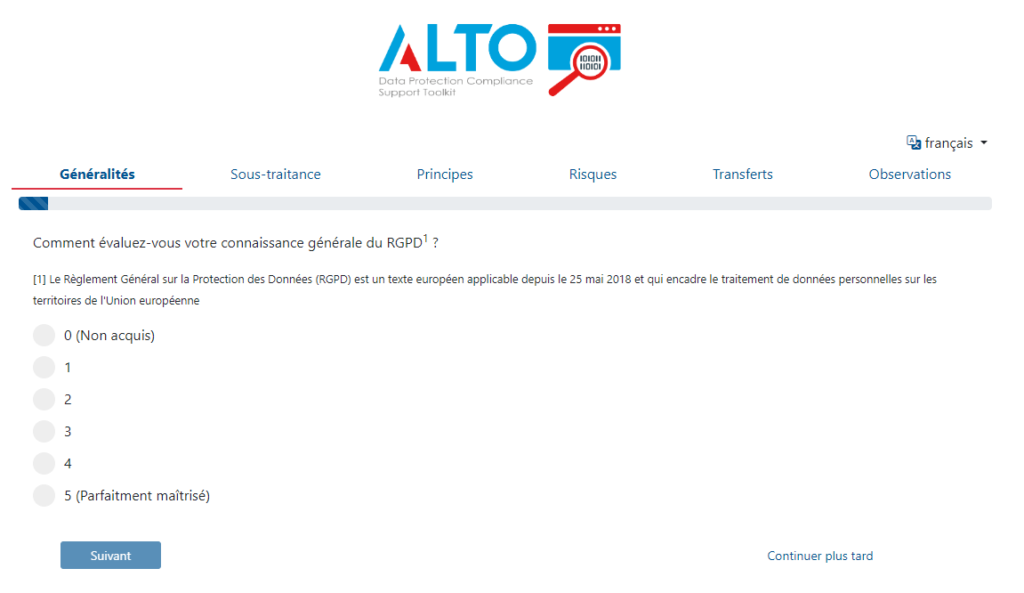
ALTO: a simple, free self-assessment tool allowing SMEs established in the Grand Duchy of Luxembourg to integrate the obligations of the General Data Protection Regulation into their activities.
As part of this project, the CNPD is now calling on all SMEs to take part in an online questionnaire, which is anonymous, or in brief interviews on the topic.
The scope of the GDPR is very wide and sanctions can be very high. You can find all the sanctions issued by the CNIL and the CNPD on their websites.
Strengthening their support offer
The main point emerging from the CNIL’s strategic plan is its wish to strengthen its support offer by making the legal framework easier to understand and more predictable, by developing compliance tools and by helping organizations guard against cyber risks. To this end, the CNIL is communicating on five areas:
- Strengthen the legal certainty of data controllers through practical and clear guidance.
- Develop certification and code-of-conduct tools.
- Make GDPR compliance the best prevention against cyber risks.
- Strengthen and develop the support strategy.
- Take on a role as a regulator with an economic impact.
The CNPD raises awareness of the security of data processing.
- On April 24, 2023, Mr Alain Herrmann, Commissioner of the CNPD, spoke at a conference on personal data organized by the Chamber of Commerce to mark the fifth anniversary of the entry into force of the General Data Protection Regulation (GDPR).
- The National Commission for Data Protection attended the Privacy Symposium 2023, an international conference aimed at facilitating dialogue, cooperation and convergence among experts, researchers and data protection authorities from around the world.
- The CNPD took part in a conference organized by the Chamber of Commerce on April 24, 2023 on personal data, to mark the fifth anniversary of the entry into force of the General Data Protection Regulation (GDPR). The main aim of this conference was to give an overview of current developments in the protection of personal data.
Ongoing support from the CNIL and the CNPD on the GDPR for companies and organizations.
Making your email campaigns GDPR-compliant: how?

Emailing, which is often part of a marketing strategy, is also covered by the regulation. It is therefore important to have a newsletter that complies with the GDPR.
To do so, pay attention to:
- The database: it must be qualified, in particular as regards consent from your subscriber list. The date, type of data and proof of acceptance must be recorded.
- Subscription:

The newsletter sign-up form must include a statement informing the user that they will receive marketing offers at their email address, and must collect their consent. This statement aims to inform the user of the purpose of the collection.
- Unsubscribing:

You must also tell the customer that they can unsubscribe and explain how to do so in the body of your newsletter email.
- Subscribers’ consent: your marketing emails must be sent to subscribers from whom you have obtained consent, which must be “free, specific, informed and unambiguous”. Avoid soft opt-in and soft opt-out techniques.
- Soft opt-in: obtaining the internet user’s consent without requiring any explicit action from them.
- Soft opt-out: the recipient of the advertising must tick a box saying “I do not wish to receive commercial offers” to avoid receiving unwanted emails.
Making your website compliant so that it is GDPR-friendly. This compliance must above all come from the company that owns the website (it is up to them to make the business decision). The agency or provider can support them in the technical implementation.

The GDPR is evolving when it comes to the compliance of websites. Websites collect a lot of data about visitors, for example through analytics tools or cookies. It is therefore becoming essential to make your website GDPR-compliant and more respectful of the personal data of the people who visit it. This compliance process is first and foremost the responsibility of the company that owns the website, as the decision is theirs to make from a business standpoint. The agency or service provider can support them with the technical implementation.
The three main principles to respect are as follows:
- The protection of personal data.
- Compliance with the rules on cookies and trackers.
- The cybersecurity of websites.
So here are five good practices to take into account for 2023:
- Communicate about the collection of personal data
- Know the purpose of collecting personal data
- Strengthen the security of users’ personal data
- Appoint your Data Protection Officer
- Update your GDPR compliance regularly
The famous Google Analytics question in 2023

In June 2022, the CNIL published two articles on its official website, the French National Commission for Informatics and Liberty, which ruled that the use of Google Analytics does not comply with the GDPR. The main reasons are the hosting of the data collected outside the EU and the incomplete pseudonymization and anonymization measures offered by the tool.
Google Analytics therefore presented a new version of its analytics tool: Google Analytics 4, GA4, on October 14, 2020.
Unlike the previous version, the announced tool uses event-based rather than session-based data. Among the changes, users’ IP addresses are no longer stored and third-party cookies will no longer be applied.
From July 1, 2023, Google Analytics users will be required to switch to the new Google Analytics 4 version. After this date, standard Universal Analytics properties will stop processing data, but you will still be able to view your Universal Analytics reports for a certain period. However, new data will only be sent to Google Analytics 4 properties.
If you have not yet done so, it is time to switch to Google Analytics 4 so as not to lose valuable data and to benefit from an optimal configuration.
Google strongly recommends migrating your Universal Analytics property to Google Analytics 4 before a property is automatically created for you. This will let you benefit from all the advantages and features of the new version, and keep all your historical data.
Reminder: what are the “GDPR regulations”?
Definition
GDPR regulations (or simply GDPR): General Data Protection Regulation: EU Regulation 2016/679 of the European Parliament and of the Council of 27 April 2016 on the protection of natural persons with regard to the processing of personal data and on the free movement of such data, repealing Directive 95/46/EC.
In other words, it is a European Union regulation that is the reference text on the protection of personal data. Its aim is to strengthen and unify data protection for individuals within the European Union.
Adopted by the European Parliament on April 27, 2016, its provisions have applied in the 27 Member States of the European Union since May 25, 2018.
Reminder: what is personal data?
Personal data is any information that directly or indirectly identifies a natural person: name, email address, IP address, photo, telephone number, etc.
The six main GDPR principles to respect
Lawfulness and fairness
Lawfulness: the collection and processing of personal data must correspond to at least one of the legal bases of Article 6 of the GDPR.
Fairness: what is described to the data subject must correspond to what is actually processed. The information must be clear so that they can give valid consent or exercise their rights.
Purpose limitation
Personal data may only be collected for “specified, explicit and legitimate” purposes (Article 5.1.b). It may only be used for the specific purposes justified at the time of collection and/or processing.
Data minimisation
The data collected must be “adequate, relevant and limited to what is necessary in relation to the purposes for which they are processed” (Article 5.1.c). This means that a company must collect only what it needs, the minimum amount of data for a specific processing operation.
Accuracy (data quality)
Data must be “accurate and, where necessary, kept up to date” (Article 5.1.d). Data holders must create processes for rectifying and deleting data about data subjects in their databases.
Storage limitation
Data must be “kept in a form which permits identification of data subjects for no longer than is necessary for the purposes for which the personal data are processed” (Article 5.1.e). In other words, data that is no longer needed must be deleted.
Integrity and confidentiality (data security)
The data holder must guarantee security, “including protection against unauthorised or unlawful processing and against accidental loss, destruction or damage” (Article 5.1.f). It must take technical and organizational security measures to prevent accidental or unlawful destruction, accidental loss, alteration, disclosure or unauthorized access.
Why is it important for website owners to take this into account?
A risk of administrative sanctions

In France, the supervisory authority for GDPR compliance is the CNIL (Commission Nationale de l’Informatique et des Libertés). It can impose sanctions on organizations subject to the GDPR of up to €10 million or 2% of turnover for breaches relating to compliance, and up to €20 million or 4% of turnover for breaches relating to individuals’ rights.
In Luxembourg, it is the CNPD (Commission nationale pour la protection des données) that is responsible for ensuring data protection in the country. It has investigative powers, can adopt all corrective measures, and has authorization and advisory powers.
A risk of criminal sanctions
The courts can also impose criminal sanctions for an organization’s failure to comply: from a fine of €1,500 for collecting personal data without first informing the data subject, up to €300,000 and five years’ imprisonment for diverting personal data from its purpose.
In 2025, the CNPD strengthened its targeted inspection strategy. It announces more checks on:
- micro-enterprises and SMEs,
- high-risk sectors (health, HR, marketing),
- compliance with consent and data security.
The CNPD also reminds that it can now impose heavier fines and publish sanctions publicly. In 2024, the sanctions revealed the same recurring reasons: lack of a record, cookies without clear consent and a lack of security.
A data-driven opportunity

The GDPR can be a genuine tool for data-driven practice. This means your company can take strategic decisions based on the analysis and interpretation of data.
Making your site GDPR friendly will allow you to:
- Strengthen trust with your clients: your company’s image can only be enhanced if users know that you respect their personal data.
- Take decisions more quickly and effectively, since the data collected will meet your objectives.
- Improve collaboration between your teams and your partners thanks to greater transparency and clear communication.
- Identify risks more easily in order to avoid them more quickly.
- Achieve better profitability thanks to more qualified data collection upstream.