
Today’s consumers are often overwhelmed by the amount of information reaching them. So how do you hold their attention?
What truly captures their attention in today’s environment is their emotions, through storytelling.
More precisely, good stories that are able to stir genuine emotions in them.
This is why digital marketing has abandoned the approach of bombarding users with the same repetitive message. Rather than simply broadcasting intrusive and impersonal advertising, marketers are seeking to engage consumers in a more subtle and interesting way. They focus on creating captivating and engaging content that tells stories, stirs emotions and builds emotional connections with the audience.
Marketing is no longer about what you make, but about the stories you tell.
Seth Godin
In this article, let us look at the value of storytelling in digital strategies and how to use it effectively.
What is storytelling?

Definition
In content marketing, storytelling, sometimes also called “narrative communication”, is an English term meaning telling a story. It is a technique that consists of telling a story in order to promote a product or brand by appealing to the emotions of the target audience.
It exists in several forms: spoken, written or visual. To find customers, retain them and sell products, storytelling can be applied to:
- videos
- text
- podcasts
- speeches
A few examples
Nike, just do it
Nike builds a whole universe around its baseline “Just Do It“, which allows its future customers to recognize themselves, feel inspired and form an attachment around the values of sport, self-transcendence and team spirit.
Oasis, be fruit
Oasis relaunched its brand by creating a storytelling strategy around its fruits. By telling stories about these friendly characters, it is able to convince its consumers once again of the tropical, fresh and light side of its products.
Apple, the iPhone in moments of life
Apple has used storytelling since its beginnings, both by telling the story of its founder and the story of its users.
The brand puts more emphasis on its brand, its philosophy and its values than on the products it sells. Highlighting its consumers’ experiences and testimonials aims to humanize it and give it a living dimension. Customers do not choose Apple solely for its products, but because they identify with its culture and values.
The fundamentals of effective storytelling

Defining the audience
Like any strategy, it is essential to start by defining the audience. Who should the message be addressed to? Define the age, gender, occupation, expectations, desires and habits of the typical people targeted. This is what will allow you to choose stories that will stir emotions in them and keep them loyal.
Defining the key message
Storytelling must revolve around a main message. Here, you need to create the story’s common thread and think about the overall message conveyed by the story. It must be as clear as possible so that the target can understand it. The message must be designed according to the emotion you want to evoke in the target.
Conveying the brand’s values
When you are defending values that some users do not necessarily adhere to at first, storytelling is very relevant. It makes it possible to use familiar characters and scenarios to show them more clearly how the story can apply to their own experience.
Driving action
The aim is generally to encourage users to repeat the same pattern as your characters.
Choosing the most effective medium
As with any communication strategy, it is essential to choose the medium best suited to sharing it. A storyteller’s narrative can take many forms: stories that are read, listened to or watched. The medium chosen will depend both on the story itself and on the target audiences.
Our advice for impactful storytelling
Three elements are essential to the message before developing the narrative: the introduction, the narrative arc and the resolution.
Here is the classic storytelling technique that has proven itself over time: the Hero’s Journey. It was developed in 1949 by Joseph Campbell and was immediately adopted around the world. This technique shows how the main character can be subjected to a specific series of events that allow them to unveil the heroic potential lying dormant within them and change the world forever.
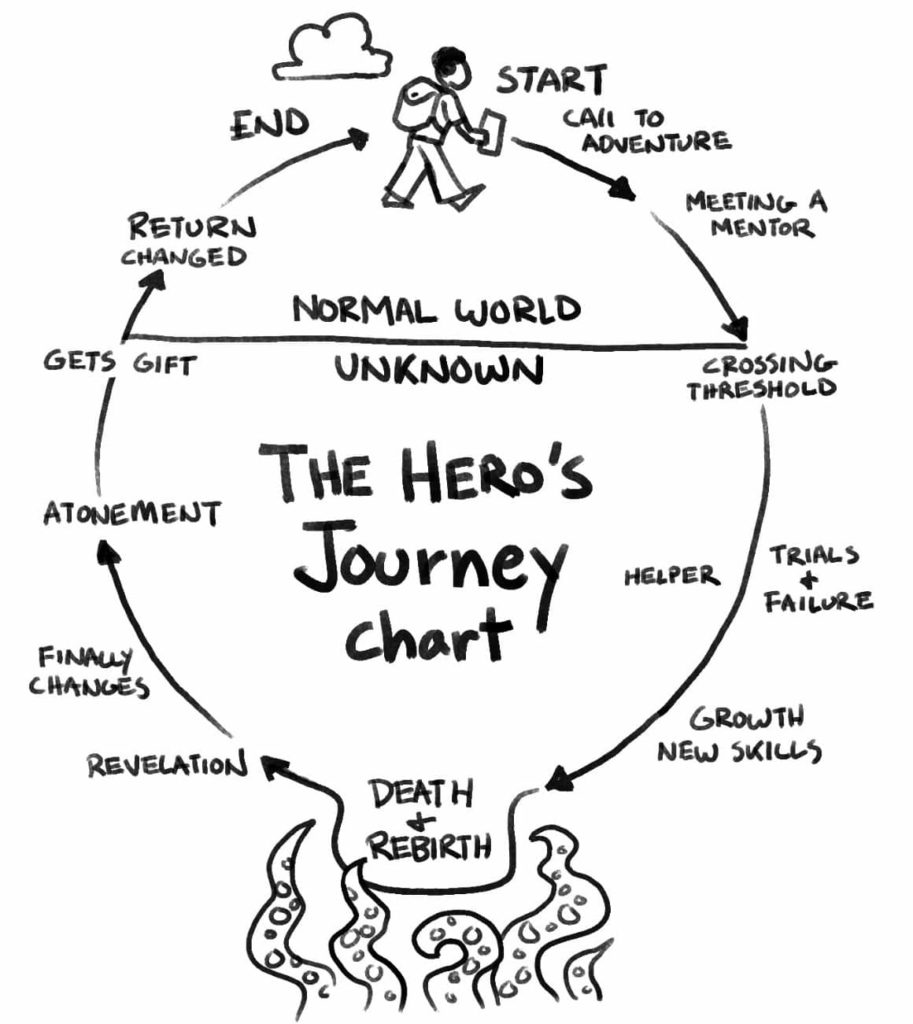
In short, a character (the target) embarks on a quest that will confront them with a series of trials, then returns triumphant with their well-deserved reward (the product or service).
The Hero’s Journey is made up of 12 stages divided into two parts:
- The “ordinary world“: the hero lives their peaceful life as a customer
- “The unknown“: the brand-new world that opens up to them as they venture out on their quest
The aim is to identify which stage prospects are at and to define a strategy to make the customer the hero of the story. You need to prove to them that the product is the ultimate reward!
In short, having a beautiful website or campaigns is one thing, but what really matters is having things to say: going deeper into how a team or products are presented, and so on.
We can support you in your approach
At h2a, we do not limit ourselves to setting up communication tools. We are convinced that the content of a website or of a communication medium is an integral part of it and therefore requires dedicated, well-crafted content.
That is why we advise our clients to establish a editorial strategy, or to work with professional copywriters.